Wednesday, August 13, 2014

O Captain, My Captain...


In memory of Robin Williams 1951-2014

Tuesday, August 5, 2014

Much Ado About Nothing

“When I said I would die a bachelor, I did not think I should live till I were married.”

If you have ever read (or seen) and enjoyed a modern romance story, then you owe a lot to William Shakespeare.  His 1598/1599 comedic play Much Ado About Nothing has set the tone for many of today's most loved romance stories and remains a classic itself.  It is a story that continues to be retold in modern interpretations all over the world and remains a personal favorite of mine.

The Plot:

Leonato, the Governor of Messina, receives word that the Spanish prince Don Pedro is arriving along with his companions after a successful battle.  One of these companions, Count Claudio, instantly falls for Leonato's daughter, Hero.  Meanwhile, Benedick, the other companion, takes his up his war of wit and words with Beatrice, Leonato's niece.  They both profess to hate each other and are constantly throwing verbal punches.  Claudio and Don Pedro come up with a scheme to convince Benedick that Beatrice is in love with him and vice versa, thus causing them to fall in love with each other.  They enlist the help of Hero and meet with immediate success.  Hero also falls for Claudio and the two become engaged.  But Don Perdro's brother, Don Jon, decides to wreck things for the lovers by convincing Claudio that Hero is being unfaithful to him.  Chaos ensues and one wonders if either couple will finally achieve happiness.

My Review (Caution - Spoilers):

This was the first Shakespeare play that I became familiar with and it remains one of my all time favorites.  It is one of those stories that seems to come off of the page with its great characters, witty repartees, and fun plot.

Though Hero and Claudio's story drives much of the action, it is Beatrice and Benedick who are the stars of the show.  I think their story is interesting because you can't tell when they actually begin to fall for each other.  Have they always harbored secret feelings for each other?  Or does percieving weakness in the other (i. e. one being in love with the other) allow them to take down their own defenses and open themselves up to love?  Whatever the cause, their transformation from sarcastic enemies to sarcastic lovers is a fun one to watch.

One of the aspects of this story that I love is the masking of one's identity.  At one point or another, almost every character pretends to be someone they aren't.  Whether it be as a barrier to protect themselves or a way to conceal themselves while creating mischief, each character plays a part that is not really his.  I think this has an interesting correlation with our society today.  We hide behind our avatars and our Twitter handles in order to protect ourselves or to shrug off responsibility for the things we do or say.  Like the characters in the story, we have to open ourselves up to each other in order to experience love and to take responsibility for our actions.

If you are looking for a place to start in Shakespeare, this is a good one.  It is probably one of his most accessible and fun plays.  Probably my favorite comedy so far.

The Performance:

Though reading Shakespeare is fun, it is also important to see it performed.  Shakespeare gives few stage directions and this allows each individual give their own interpretation of the characters an their actions.

I watched Joss Whedon's 2012 film starring Alexis Denisof, Amy Acker, Nathan Fillion, and a host of other people from other Whedon productions.  Though the dialogue is all Shakespeare, the setting is modern.  I truly love this film.  While it is faithful to Shakespeare's lines and plot, its setting allows for a fun and modern interpretation.  All of the actors are outstanding, and Nathan Fillion is especially endearing as the hapless constable, Dogberry.  I also loved how they took the songs in the original play and set them to modern music.  I highly recommend this!

Do you have a favorite performance of this play?  Share with us in the comments!    

Monday, July 28, 2014

Bucket List

Hannah at Miss Daydreamer's Place recently tagged me for the Bucket List Tag.  The idea is to list 10 things you want to do before you die and then tag other friends to do the same.  Although my bucket list (like my to be read list) is EXTREMELY long, I was able to pin down 10 goals that mean the most to me right now.


Visit my ancestor's native town of Ensingen, Germany

My father's side of the family arrived in America in the 1880s.  Before that, the family lived in the small town of Ensingen in Baden-Wurttemberg, Germany.  The town is 900 years old and has long been a wine making center of the southwest.

Learn to play the dulcimer

Variations of dulcimers (meaning "sweet song") are found all over the world.  The hammered dulcimer is especially popular in many cultures.  The one I want to learn is often called the "Mountain Dulcimer" and its roots are found in Appalachia.  Though I don't really have any background in playing music, this is an instrument I'd love to try.  Listen to one here

.    Ring in the New Year in Times Square

There is perhaps nowhere more iconic to spend New Year's Eve than in Times Square.  Watching the ball drop and the confetti fall is a part of every American's celebration.  Just once, I'd love to celebrate in person with millions of other people, hearing the strains of "Auld Lang Syne" promptly followed by "New York, New York".


Have a Middle Earth marathon

This one is kind of different, but it is one that my entire family wants to do.  We want to sit down and watch all three "The Hobbit" films immediately followed by all three "Lord of the Rings" films.  Geeky?  Yes, but also worth it!

Walk the Camino de Santiago

Following an ancient pilgrimage route along Spain's northern coast, this trip has become very popular in recent years.  It takes about 4 weeks, and can be done high class or "roughing it".  This idea of combining immersion in Spanish culture with a spiritual aspect is very appealing to me.

See a play at The Globe

This is something I wanted to do when I was in London but didn't have the opportunity.  This is seeing Shakespeare as it was meant to be seen.

Visit the Bronte Parsonage Museum

I love the Bronte sisters, and the very idea of seeing the house where they grew up and where their imaginations were fed makes me giddy.  Combine this with standing on the Yorkshire moors and I think I would die from emotional overload.
Have a home library

Right now, my books are crammed in any available space.  One day, I hope to have a room dedicated to my collection.  With a window seat, of course.

Become a certified genealogist

I have been obsessed with genealogy for years and I hope to one day become a certified genealogist and do some freelance work.

Become fluent in French

I have long loved to study language and French is by far my favorite.  Though I only have a basic vocabulary now, I'd love to become fairly fluent in it.  Guess that means I'll just have to move to Paris!

At this point I'm supposed to tag some people.  I don't have that many indvidual bloggers that I interact with, so I am going to go with hopeinbrazil at Worthwhile Books.  And to anyone else who would like to participate, jump in and link to your post in the comments!

Saturday, July 26, 2014

Just for Fun


Thought this would be fun to post since I am almost two thirds of the way through my summer reading of Shakespeare.  From the 1953 version of Cole Porter's Kiss Me Kate, here is "Brush Up Your Shakespeare".

Wednesday, July 23, 2014

The Black Count

All over the world, Alexandre Dumas is recognized as one of the titans of French literature.  The swashbuckling adventures found in his works like The Three Musketeers, The Count of Monte Cristo, and The Man in the Iron Mask portray a world of honor, betrayal, love, and friendship.  But though his stories are some of Western civilization's most famous, few people realize that many of their most famous elements are based on the character and exploits of one very real person...his father, General Thomas-Alexandre Dumas. In his Pulitzer Prize winning book The Black Count: Glory, Revolution, Betrayal, and the Real Count of Monte Cristo, Tom Reiss seeks to tell the general's story and to reveal how his larger than life presence impacted his son and the art he was to create.


Thomas-Alexandre Dumas was born in the French sugar colony of Saint Domingue, the son of a French aristocrat and a his black slave.  At the age of 14, his father sold him and three other siblings into slavery in order to raise funds for passage back to France.  He was later repurchased by his father and then raised in France.  He received the education of any French noble, mastering the arts of fencing, riding and literature.  But as his father's fortune dwindled due to lavish spending on a new wife, Dumas assumed his mother's name and enlisted in the French military.  It wasn't long before he distinguished himself as a member of the Queens Dragoons.  As the old regime fell and France was swept up in revolution, Dumas took advantage of the new found freedoms and rose higher and higher, eventually reaching the rank of General of the French Army.  But Dumas' fortunes, like those of France, were soon to be forever changed by an intelligent and ruthless man from Corsica.

I found this book to be extremely fascinating.  I have always loved Dumas' work, but I had no idea that so many of his stories, especially The Count of Monte Cristo, were based on his father's life.  And General Dumas' story in many ways rivals those of his son's creation.  It is obvious that, though raised as an aristocrat, he is very much a man of the Republic.  He firmly holds on to the ideals of the revolution, even when others twist them for their own use, or seek to undermine them.  He is also a consummate leader and warrior, garnering the respect of his men and overcoming some of the most difficult situations that can be thrown at a soldier.  His rise in the army is meteoric.  In fact, he was the highest ranking black commander in a white army until Colin Powell became a four-star general in 1989.

But the story the Reiss tells here is not just Dumas', but also the story of all people of color in revolutionary France.  France was one of the first European powers to pass laws against slavery, even though it's rich sugar colonies were firmly built on them.  This allowed blacks and people of mixed race to rise as high in French society as whites, and for their children to be educated alongside them.  And the revolution extended the idea of liberty and equality to all Frenchmen, allowing Dumas to not only command a white army, but also to marry a white woman.  Unfortunately, even as these ideals crumbled before Napoleon's ambition, so did the freedoms of blacks all over France.  Eventually, slavery would be brought back to the French colonies.  It is all too obvious that the reason so few people, French or otherwise, know anything about Dumas is because of racism.

As a non-fiction book, this reads very easily.  Reiss packs in a lot of information, but delivers it in such a fun and adventurous way that you feel as if you are reading a novel.  His writing is easily read and well paced, allowing even the least scholarly among us to grasp what is happening.  It also really helped me understand the timeline of the French Revolution as well as the many issues the caused it to happen.

I highly recommend this book to anyone.  If you love the works of Dumas, or are interested in the French Revolution, military history, race relations in France, or the French sugar colonies then you could do far worse than to read this.  It is certainly a wonderful tribute to a man whose contribution to French history has been all but forgotten.      

Monday, July 14, 2014

Books in Odd Places

In a world where almost everything has become mobile or accessible while on the go, it is no surprise that books have become that way too.  We can listen to them in our cars, or read them on our devices wherever we happen to be.  But books are beginning to make appearances in some rather odd places as well.  Here is a look at some of the random places you can find books nowadays.


New and Improved Bookmobiles
Bookmobiles have existed in America since they were wagons pulled by horses.  And though you may think this style of borrowing books is a thing of the past, many cities continue to embrace it and to use it to bring more than just books to their patrons.  The El Paso Bookmobile makes stops all over the city and includes services found at the main branches like internet access and storytelling.
Beach Reads

Though reading is as much a part of the beach as sand, sun, and water, it usually means you have to lug all of your books with you.  Until now.  From Spain and Australia to France and Tel Aviv, beaches all over the world are seeing more and more pop up libraries opening for visitors.  The libraries are usually free and patrons are encouraged to leave favorite reads of their own for others to enjoy.

Your Next Read is Calling

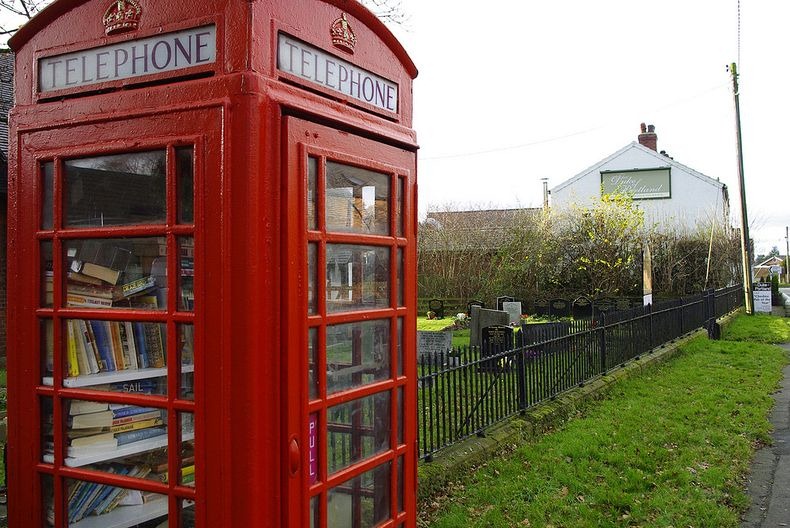
Due to the rise in cell phone usage, Britain has seen the need for the iconc red phone booth fall to just about nothing.  Many towns and villages, however, have chosen to save their booths by turning them into lending libraries for the community.  Readers simply use the box as an exchange place, picking up new reads and leaving others.

Little Free Libraries
Americans are getting in the spirit too (but without the cool phone booths).  All over the country "little free libraries" are popping up in big cities and small towns.  The idea of "take a book, leave a book" keeps the library stocked and neighbors can enjoy sharing books amongst each other in one convenient place.  There is even a website dedicated to helping you find a library near you, or giving you ideas on how to start your own. 
Have you noticed books popping up in unexpected places?  Share them with us! 

Saturday, July 12, 2014

Hamlet

“There are more things in Heaven and Earth, Horatio, than are dreamt of in your philosophy.”

Of all the plays and poems written by William Shakespeare, there is perhaps none as iconic as Hamlet.  It is required reading for many students around the world and its lines and images are often what we envision when we think of Shakespeare.  It seems to have been his most popular play in his lifetime, and the role of the Danish prince remains a right of passage for today's Shakespearean actors. 

The Plot:

Prince Hamlet is mourning the recent passing of his father, the King of Denmark.  His uncle Claudius has assumed the throne and hastily married Hamlet's mother, Queen Gertrude.  Hamlet is told of the mysterious sightings of a ghost resembling his dead father who is haunting the castle.  He goes to investigate and discovers that it is indeed the ghost of the old king.  The king tells Hamlet that he was was cruelly murdered by Claudius who coveted both his crown and his queen, and he charges Hamlet to exact revenge by killing Claudius.

Hamlet is uncertain of whether he can trust the ghost.  He begins to act as if he has lost his wits and Claudius and Gertrude struggle to understand what may have caused it.  There is talk that he may be crazy due to love for Ophelia whose father, the Chief Counselor, has opposed the match.  Events soon convince Hamlet that the ghost's story is true and he seeks to enact his revenge, even as Claudius tries to secretly have Hamlet killed.

My Review (Caution - Spoilers):

Like most people, I was pretty familiar with the plot of Hamlet, though I had never actually read it.  It is Shakespeare's longest play and at times it can certainly feel like it.  The action alternates between slow and quick which at times can give it an uneven feeling.  But this is a classic for a reason and you can certainly see the influence it has had on our modern stories.

There is a lot going on this play that really highlights the upheaval of Shakespeare's time.  In many ways, the play has both a "modern" and a "medieval" feel.  The setting has a medieval feel with the ghost of a warrior king, revenge, and discussions of purgatory and "Christian burial".  But other parts, especially Hamlet himself, have a much more Renaissance flavor with lots of philosophizing, skepticism of the supernatural, and madness.  That is probably part of the reason the play remains popular today, because there are elements that we recognize as belonging to our times and not just the distant past.

This is one of the most quoted works in English literature and I was constantly discovering phrases that I did not realize came from this play.  Phrases like "To thine own self be true", "method in the madness", "Brevity is the soul of wit", "Sweets to the sweet", and "The lady doth protest too much".  Again, because it is such a huge part of our culture, everything about this play felt familiar.  That is great in some ways, but it also kept me from completely loving the play as there didn't seem to be anything "new" for me to discover.

I think this is a play that everyone should read simply to understand the cultural implications of the work.  It is certainly one of English literature's most important works, and Shakespeare's as well.  A good play, I just don't see it being one of my all time favorites.

The Performance:

 Though reading Shakespeare is fun, it is also important to see it performed.  Shakespeare gives few stage directions and this allows each individual give their own interpretation of the characters an their actions.

I watched the 2009 PBS Great Performances version starring David Tennant as Hamlet.  It has a modern spin that is nice without being distracting.  The performances were also great with Tennant pulling off a Hamlet that could easily flip between sober and reflective to crazy and unpredictable.  Patrick Stewart was also wonderful as Claudius/Ghost, but who would expect anything less.  There are some scenes that are cut (Fortinbras does not come in at the end of the play), but overall it is a wonderful adaptation of the play.

Do you have a favorite performance of this play?  Share it below!