Showing posts with label Modern Literature. Show all posts

Thursday, January 15, 2015

Lila


“It felt very good to have him walking beside her. Good like rest and quiet, like something you could live without but you needed anyway. That you had to learn how to miss, and then you'd never stop missing it.”

It isn't often that contemporary literature touches my soul, but Marilynne Robinson's "Gilead" novels (Gilead and Home) have certainly done that.  When I heard that another novel set in the small Iowa town was to be released last October, I knew immediately that I would have to read it.  Not only does it take us back to a world of simple beauty and intense faith, it also provides us with the history of a woman who has lingered on the edge the story and only hinted at her true depth of character.

The Plot:

This is the story of Lila, the wife of Reverand John Ames whose story is told in Gilead.  As a young child, she was taken away from a neglectful home by a drifter named Doll.  Raised on the road, in constant search of work, shelter, and food, Lila's childhood and youth was rough and broken yet there were many good/happy memories as well.

After Lila becomes and adult and she and Doll are separated, she finds herself in even darker circumstances.  Hell bent on escaping it, Lila leaves St. Louis and eventually finds herself on the outskirts of the small Iowa town of Gilead.  It is there that she meets Rev. Ames, who seems to offer her a chance at peace, safety, and love.  But trust has never been a luxury that Lila could afford, and not a day goes by that she doesn't have to choose between staying in the quiet town or searching for freedom out on the road.

My Review (Caution - Spoilers):

Ever since I read Gilead, I have been dying to know more about Lila.  She played an interesting role in both of Robinson's novels whether it was her quiet devotion to Rev. Ames or the sympathy she seemed to have with Jack Boughton.  I think Robinson satisfied every longing I had with this one.

I have always delighted in how Robinson portrays the beauty of grace and the Christian faith.  As with the other two novels, we get to see grace played out in the life of one of the characters, but in a completely different way.  Rev. Ames is the man who has been secure in his faith for a long time, Jack Boughton is the man who is running from the faith of his father, and Lila discovers grace for the first time and slowly learns to embrace it.  She is someone who has never been offered true rest, quiet, and safety.  Rev. Ames offers it to her, demanding no explanations, no guarantees, and no apologies.  I think it is a beautiful picture of the life that Christ offers us.  He gives us love and grace regardless of our past.

But though Robinson portrays the beauty of God's grace, she doesn't ignore the difficulties we can have with reconciling our faith with our lives.  Though her childhood was by no means easy, it is obvious that Lila has a deep affection for the people she knew in her youth.  As she learns more about Rev. Ames' faith, she learns that her friends may not have been "saved" and this is something she can't bear to think about.  Trying to balance what we believe with what we actually experience in life is quite possibly the hardest part of being a Christian.  Robinson does a wonderful job of showing us that we can allow ourselves to question our faith.  To not shy away from the hard questions but to ask them and wrestle with them.

As always, Robinson's prose is simply stunning.  I will say that the format of this book took some getting used too.  Rather than being a letter or novel by an educated person, it is the disjointed thoughts and feelings of a woman who has not received as much education.  Time skips around and events don't really follow each other like normal.  But it makes sense for the character and becomes easier to follow as you go along.

This is certainly a fitting addition to the "Gilead" series.  Though I think I will always love and identify with Gilead the most, the raw beauty of this one touched me and dealt with a lot of my own thoughts and struggles from the past couple of years.  Do yourself a favor and pick this one up.      

Thursday, October 16, 2014

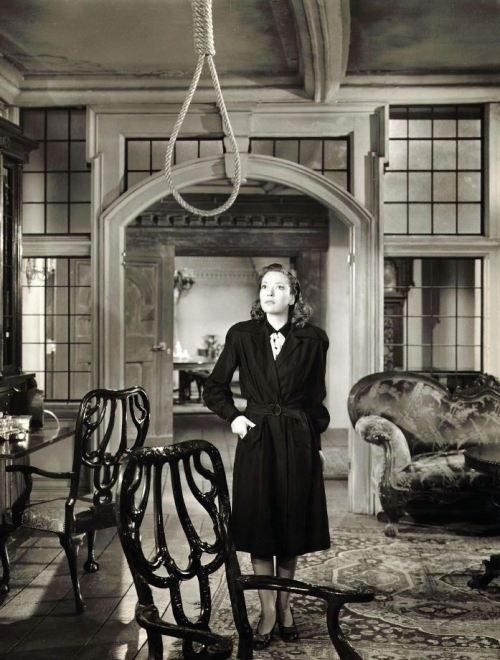
Dragonwyck

He was all sin and mystery, and Miranda feared the pleasures he offered as she feared the fires of hell. Yet when she succumbed at last, it was not because her body was weak but because her mind was curious.

Beginning in the 1940s, American author Anya Seton began writing historical romances.  Her subjects ranged from Katherine, the wife of John of Gaunt to Elizabeth Fones, niece to the first governor of the Massachusetts Bay Colony.  Her works would go on to influence many later writers, including Phillipa Gregory.  Her 1944 novel Dragonwyck is set a hundred years earlier when a still young American nation was trying to determine exactly what constituted true freedom.

The Plot:

Miranda Wells is a young woman who has spent her entire life on the family farm in the Hudson River Valley of New York.  She chafes at her family's humble life and yearns to find adventure outside of the farming community.  She gets her chance when her mother receives a letter from a distant relation, Nicholas Van Ryn, who asks that one of her daughters come and live at the family estate known as Dragonwyck and become a governess for his daughter, Katrine.  Miranda gleefully accepts and is soon taken with the handsome and cultured Mr. Van Ryn, though his wife is anything but welcoming.

Life at Dragonwyck is different from anything Miranda could have expected.  Not only is she out of her depth in this grand society, but there is also a dark and mysterious presence that seems to haunt the house.  When tragedy makes a way for Miranda to attain the life she has always dreamed of, she finds that neither Nicholas nor Dragonwyck are truly what they seem.

My Review (Caution - Spoilers):

This is just one of those books that rings all of my bells.  Historic setting...check.   Mysterious house with a Gothic touch...check.  A magnetic and dangerous love interest...check.  Though it isn't great literature in the way a Bronte novel is, it was still very enjoyable.  It reminded me a lot of Daphne du Maurier's works.

The historical setting for this was very fascinating.  I had no idea that there was an almost feudal land system in America until I was introduced to this story.  This system was left over from the Dutch settlers of early New York and forced the tenants to pay the "patroon" in goods and services.  It is against this dying system that Seton sets her story.  Like the plantation owners of the South, Nicholas refuses to believe that his way of life will ever come to an end and he cannot understand why his tenants would want the change.  Seton doesn't just use historical settings in her novels, but also historical figures.  Writers like Edgar Allen Poe and James Fenimore Cooper make appearances in the story without it a jarring effect on the reader.

Though we see everything through Miranda's eyes, it is Nicholas who drives the story.  His personality is forceful and magnetic, and though you are never able to come to love him like you would Mr. Rochester or Maxim de Winter, you can't hep but be interested in him.  It is pretty obvious from the beginning that his relationship with Miranda has all the marks of an abusive one.  Nicholas is the type of person who believes that he can have anything he wants by sheer willpower.  But fate is the ultimate master and Nicholas must watch as the things he values most in his life are taken from him one by one.

As I said, this book had so many of things I love in my reading life.  If you are someone who likes historical romances or Gothic stories, this one is for you.  It has some fascinating aspects that will make it hard to put down.

The Movie:

I was introduced to this story by the 1946 film starring Gene Tierney, Vincent Price, Walter Huston, and Anne Revere.  It follows the book pretty well though it does end differently.  Vincent Price is simply masterful as the polished yet ruthless Van Ryn.  Great for classic film fans even if you don't read the book.

Sunday, May 18, 2014

And Then There Were None

“But no artist, I now realize, can be satisfied with art alone. There is a natural craving for recognition which cannot be gain-said.” 

There is perhaps no mystery author as beloved and admired as the Queen of Crime, Agatha Christie.  She wrote 66 mystery novels in her career, with many memorable plots, characters, and endings.  But for many people, her 1939 novel And Then There Were None is her masterpiece.  It's unfathomable mystery and shocking end have made it not only the best-selling mystery novel of all time, but also one of the top selling of all books.

The Plot:

Ten people have arrived at a private island on the coast of Devonshire.  Some have been invited as guests, others as employees, of the owners.  But none have ever met them.  Upon arrival, they find that their hosts/employers have not yet arrived.  Though the house is a modern mansion, they notice odd little things like a framed "Ten Little Indians" poem on each bedroom wall and corresponding Indian figurines on the dining room table.  After dinner, the butler plays a record (per written instructions) that accuses each person of having committed murder but evaded justice.  All are shocked and dismayed, but insist they are innocent.
Then the deaths begin.  One by one, guests are being killed in ways to reflect the deaths in the bedroom poem.  The others search the island for the killer, but soon realize that he/she must be among them.  As the murders continue, each survivor struggles to decide who they can and cannot trust.

My Review (Caution - Spoilers):

Though I am familiar with many of Agatha Christie's stories, this is only the second book I have read.  Unlike The Murder of Roger Ackroyd, this particular novel does not involve a specific detective.

This mystery is fast paced and very intriguing.  From the first moment we are asking questions, and they don't stop anytime soon.  Who are the owners of the island?  What is their purpose in bringing the guests to the island?  Are the guests really guilty of murder? Who is doing the killing?  Christie sucks us in from the very beginning and never lets up.  The growing panic and confusion among the guests transfers to the reader creating a rather intense reading experience.  It is the smart reader indeed who can explain the mystery before Christie's big reveal.

I thought the use of the poem in the murders was clever, and in some ways increased the tension as you waited for the next inevitable murder.  Of course, this also decreases the suspense somewhat as we know how many people are supposed to die as well as the way they die.  I also felt that the explanation, while clever (and similar to the surprise of Ackroyd), was also rather convenient in some places.  There just didn't seem to be enough time for the killer to complete some of these murders without being caught.  But though these thoughts were in the back of my mind, it didn't diminish my enjoyment of the novel.

It is clear that nobody writes crime like Agatha Christie.  Her storytelling is tight, her plots are brilliant, and her endings are surprising.  If you have never tried a Christie novel, And Then There Were None is a great place to start.  It is no wonder that it remains popular with readers the world over.

The Movie:  
  
There is a 1945 adaptation starring Walter Huston, C. Aubrey Smith, and Judith Anderson.  I haven't seen it, but I love these actors and will definitely try to see it soon.    

Sunday, April 6, 2014

Fahrenheit 451

“There must be something in books, something we can’t imagine, to make a woman stay in a burning house; there must be something there. You don’t stay for nothing.”

In 1951, Ray Bradbury sat in the basement of UCLA's Powell Library typing what would become his most famous work on a rented typewriter.  In the age of McCarthyism,  Bradbury set out to warn the world what would happen if society allowed censorship to rule the day and the loneliness that would be found in a world without books.  Over 50 years later, his warnings are just as important as our own world begins to look increasingly like the one of his creation.

The Plot:

Guy Montag is a fireman at an unspecified time in the future.  Unlike the firemen of the past, their job is to set fires, not put them out.  Books have been banned, and anyone who is found to have them has their house and belongings destroyed by the firemen.  Things have been this way for as long as he can remember, so Guy doesn't question them.  That is, until he meets a young woman named Clarisse, whose free thinking ideals and free spirit cause him to see things differently.  And so begins the un-ravelling of his world as he begins to question everything he has ever believed, and wonders what exactly is inside those books that makes them so dangerous to so some, and so important to others.

My Review (Caution - Spoilers):

This is one of the books that I have meant to read for a long time and just never got around to.  It is ranked among the top of dystopian novels along with Brave New World and 1984.  In many ways, I found the book to mean more in today's times than it might have 50 years ago.

Censorship is the main issue that Bradbury tackles in this novella.  We have a society that has banned all books in an effort to "protect" people, but what I find fascinating is that unlike other dystopian novels and examples in history, this change has come from society itself and not from the government in charge of it.  Books were banned little by little because different groups found "offensive" material in them.  In effect, political correctness led to the end of books because people could always find something offensive in them.  Sounds a lot like the times we live in.  Our society's answer to everything we find offensive is not to argue against it with sound logic, or even just ignore it, but rather to ban it all together.

You can also see glimpses of our society in other areas.  Like the citizens of the novel, we have begun to live vicariously through other mediums.  We trade personal interaction for time in front of our TVs.  We have friends over, not to talk to and learn from each other, but to watch other people's lives unfold on the screen.  A great example of this is how Mildred can't remember how she and Guy met, but she refers to the people on her TV as family.  Our real life experiences somehow feel less real than the things that happen in media.

The only real problem I had with this book was that it was so short.  I felt like there were so many themes and issues that could have been fleshed out more than they were.  I guess this is because Bradbury had to rent his typewriter, but still everything seems to happen almost too fast.  Guy goes from having no clue about what is in books to an enraged passion for them in what seems like a couple of days.  

Besides that quibble, this is certainly a book that should continue to be read.  Bradbury's imaginary future is eerily similar to our world, and it is important to head the warnings found here or our fate might be worse than the one at the end.  If you haven't read this one, you really should.

The Movie:

In 1966, a film adaptation was made starring Julie Chritie and Oskar Werner.  I have not seen it, but Bradbury was pleased with it.             

Friday, March 14, 2014

Night

“Never shall I forget that night, the first night in camp, which has turned my life into one long night, seven times cursed and seven times sealed....Never shall I forget those moments which murdered my God and my soul and turned my dreams to dust. Never shall I forget these things, even if I am condemned to live as long as God Himself. Never.” 

There are, perhaps, few events in history that still have the power over us the way the holocaust does.  Nothing else seems so unfathomable, makes us recoil in horror, and draws pity from our hearts like the suffering of the European Jews during WWII.  And yet, the story is now so familiar that we are in danger of being desensitized to it.  In this slim volume, survivor Elie Wiesel recounts not only his own story, but also that of 60 million other people.  Knowing that he cannot remain silent, he begs the world to never forget.

The Plot:

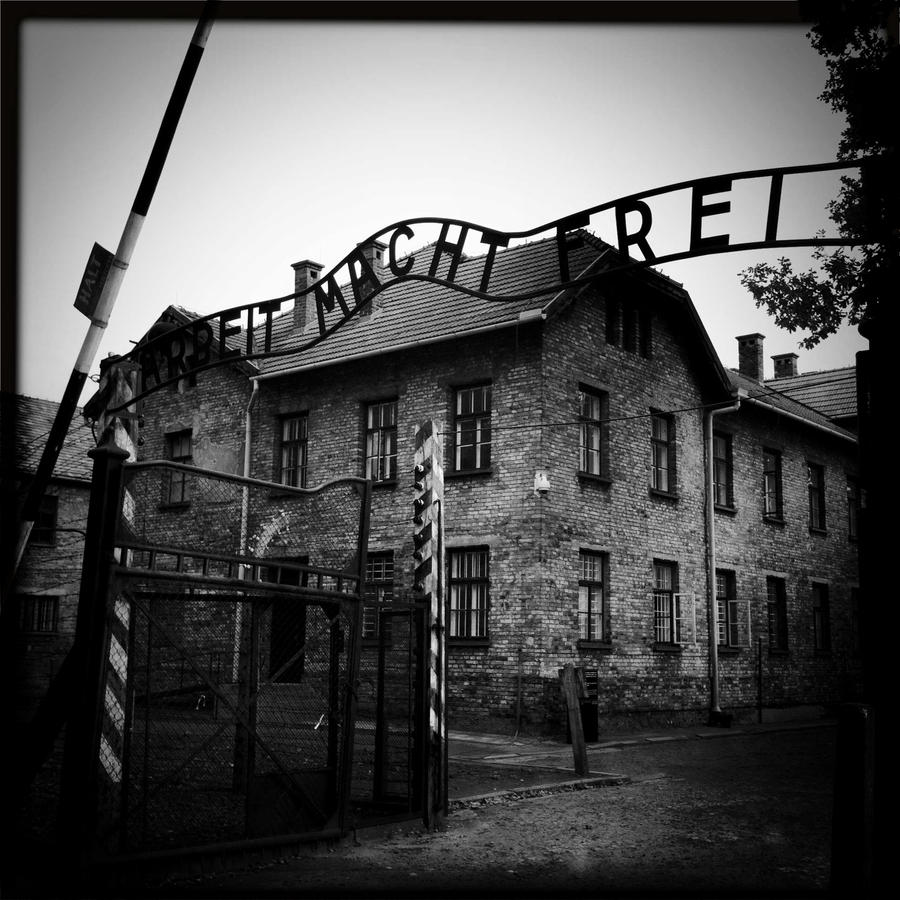
Romanian-born American author Elie Wiesel tells of his fate and that of his family in the period of 1941-1945.  He tells of the early years when his small community felt little affect from the war raging in Europe.  Of the time in the Ghetto when they thought the war would end before any real harm came to them.  Of the nightmarish journey in cattle cars to impending death.  And of the horrific years spent simply trying to stay alive in Auschwitz and Buchenwald. 

My Review (Caution - Spoilers):

The Second World War is a period in history that has long held my fascination.  I have pored over books and watched many films and documentaries.  And in all that time, I don't think I have ever come across one that I have found as powerful as this.  Perhaps it is because the story wasn't being told by experts, scholars, and talking heads, but rather by someone who lived and breathed the horror.

There is nothing beautiful about this book.  It is stark.  It is horrific.  It is raw.  Wiesel describes in detail all of the horrible realities of life in a German concentration camp.  It was so honest that it often became difficult to read.  I imagined my own family in those circumstances; watching my own father slowly die before my eyes; seeing my own little sister go to her death in a bright red coat.  Each of us, no matter our circumstances, can easily imagine ourselves in the shoes of the European Jews.

Perhaps what is most disturbing, beyond the never ending slaughter, is the fact that the Nazis believed the Jews to be sub-human and so consquently stripped them of everything that made them human.  Life simply became a matter of surviving the next moment.  Even Elie found himself abandoning his own father in an attempt to simply keep living.  I think what I found most heartbreaking was seeing Elie being stripped of the faith he had once held so dear.  He was a boy who spent much of his life in study and prayer and yet in the end he would feel abandoned and punished by the God he loved.  So much so that his faith became non-existent.

As a Christian, this book is challenging in that it is so difficult to see God in the midst of the horror.  Like Elie, we are left to wonder where God was and how he could abandon his chosen people to such a fate.  How do we talk of the love of God to someone who has been through what Elie and his family went through?  In his foreword to the book, French author Francois Mauriac describes his own difficulty:  

And I, who believe that God is love, what answer could I give my young questioner, whose dark eyes still held the reflection of that angelic sadness which had appeared one day upon the face of the hanged child?  What did I say to him? Did I speak of that other Jew, his brother, who may have resembled him—the Crucified, whose Cross has conquered the world? Did I affirm that the stumbling block to his faith was the cornerstone of mine, and that the conformity between the Cross and the suffering of men was in my eyes the key to that impenetrable mystery whereon the faith of his childhood had perished? Zion, however, has risen up again from the crematories and the charnel houses. The Jewish nation has been resurrected from among its thousands of dead. It is through them that it lives again. We do not know the worth of one single drop of blood, one single tear. All is grace. If the Eternal is the Eternal, the last word for each one of us belongs to Him. This is what I should have told this Jewish child. But I could only embrace him, weeping.

Though it is by no means an easy book to read, it is one that we must.  Read it because they died.  Read it because they were human.  Read it because the survivors cry out.  Read it because so many turned a blind eye.  Read it so that it may not be forgotten.  Read it because you live.         

Sunday, February 23, 2014

The Book Thief

“I have hated words and I have loved them, and I hope I have made them right.”

Published in 2005, Australian writer Marcus Zusak's fifth novel quickly rose on the NY Times Best Seller List and would go on to win numerous awards.  Zusak says that the inspiration for the story's setting of Nazi Germany came from the stories his parents told of growing up in Germany and Austria during that period.  In this novel, we see the complications and dangers of war played out in the lives of young people and the power that words have, both for good and for evil.

The Plot:

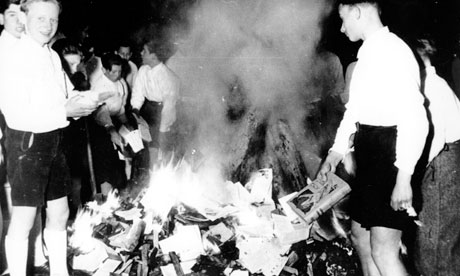
The story is narrated by Death and set in Nazi Germany, a time and place that is keeping him very busy.  He first encounters Liesel Meminger ("The Book Thief") when her little brother dies on their way to a new foster family.  Liesel arrives alone at the house of Hans and Rosa Hubermann.  Though Rosa is hot-tempered and abrasive towards Liesel, Hans immediately takes to her and begins teaching her to read.  Liesel settles into life on Himmel St. and becomes friends with a neighbor boy named Rudy Steiner.  At a Nazi book-burning ceremony, Liesel (who is now obsessed with reading) secretly takes a book that survived the fire and brings it home.  Her book stealing days really begin there.

Life changes dramatically when Max Vandenburg, a Jew, arrives at their house and Hans and Rosa hide him in the basement.  He and Liesel soon bond over their love of books and their shared anxieties.  But as the war rages on, life on Himmel St. becomes more and more dangerous.  Bombings, rationing, and the ever present threat of the Nazis discovering Max.

My Review (Caution - Spoilers):

This book has garnered lots of praise and buzz ever since it came out.  It certainly seems to have affected many people and it has earned rave reviews from many readers.  With the recently released film version, I figured it was time to give this one a try.

One of the most interesting aspects of this novel is its setting on the German side of World War II.  While Zusak is quick to emphasize the real horror and tragedy that the Jewish people went through, he also recognizes that they are not the only victims.  We tend to look back on that period and lump all Germans under the "Nazi" label.  What we often don't realize is that many Germans were victims as well.  They were young people who had no say in what happened to their nation and what they were instructed believe.  They were men and women who were forced to accept (at least on the surface) things they did not really believe in order to protect their families.  They were people who didn't ask for war, and yet lost their lives in bombings.  By the end of the novel, we feel the pain of loss of many characters and realize that war makes victims of us all.

But this isn't just a novel about war, it is also about words.  As readers, we know that words are powerful and can change the world.  What we perhaps fail to realize is that it is the reader/speaker that determines how that power is used.  Max often ponders how Hitler is able to use the power of words to drill horrible beliefs into the German people, and yet ironically his path to safety is hidden in the pages of Mein Kampf.  To me, this is why book burning and book censorship is so crazy.  The mere existence of words does not threaten people, but rather what we choose to do with them.  Wise words have often been twisted by people to use for their own evil purposes.  And sometimes, words meant to bring pain have been used to bring about good.  It is us who determine what their ultimate fate will be.  Perhaps the most powerful moment in the book regarding this is when Liesel is reading the book she saved from the fire to her neighbors in the bomb shelter.  A book that the Nazis tried to burn for fear that it would make their citizens weak actually serves to bring them comfort and make them strong even as their world is crumbling around them.

Now, as far as The Book Thief itself, I didn't particuarly have strong feelings about it one way or another.   I certainly didn't hate it and found many interesting aspects to the story, but it was by no means a "life-changing" one.  I kind of feel like I might have connected more if Liesel herself had been the narrator.  The use of Death as a narrator, though interesting, made for a lack of intimacy and in some ways sympathy that are necessary to really pull a story like this off.  I'm glad I read it, but it isn't one that I see myself reading over and over again in the coming years.

Though it is by no means a perfect book, I still don't mind recommending it.  It has some good messages, and it has certainly struck a chord with many readers.  If it sounds like something that would interest you, go for it.  It is worth reading at least once.

The Movie:

The book was recently adapted into a major motion picture starring Geoffrey Rush, Emily Watson, and Sophie Nelisse.  It has received mixed reviews, but I have not yet seen it and so cannot comment.  Please let us know your impression of it if you have seen it.                        

Sunday, January 5, 2014

The Fault in Our Stars

“You don't get to choose if you get hurt in this world...but you do have some say in who hurts you. I like my choices.”

The Fault in Our Stars is the fifth novel by YA author John Green.  Released in 2012, it was widely anticipated and soon landed on the NY Times Bestseller List.  Drawing on his experience as a chaplain at a children's hospital and his friendship with a young woman dying of cancer, Green uses this seemingly stark and simple story to ask big questions about life, death, and all of the moments in between.

The Plot:

Sixteen year old Hazel Grace Lancaster is dying.  Her Stage 4 thyroid cancer is only held in check by an experimental drug.  Since the condition of her lungs means she can't go to school, her parents force her to go to a local support group for children living with cancer.  She resents the meetings at first, but then she meets Augustus "Gus" Waters whose cancer is in remission.

There is an almost instant attraction between the two.  They begin spending more and more time together discussing movies, life, and books.  They especially bond over Hazel's favorite book (about a young girl also dying of cancer) and spend time discussing what might have happened after the book ended.  But even as their relationship deepens, Hazel feels that she must pull away.  She is still dying and the last thing she wants to do is to cause Gus pain.  As circumstances change, both Gus and Hazel must decide if their love is worth the pain that will inevitably come.

My Review (Caution - Spoilers):

John Green's name has been on the edges of my reading radar for awhile.  It is no secret that he is a bit of a god to the nerds of the world (whom he calls "nerdfighters").  I've enjoyed hearing his views on literature, and watching the "Crash Course" videos he created with his brother, Hank.  But until now, I had never read any of his works.

I feel like one of the hallmarks of a good book is that you are still thinking about it days, even weeks after you finish reading it.  And that certainly happened to me with this one.  This is not just a teen romance story, or even just a story about kids with cancer.  This book tackles really big philosophical subjects.  One of the ones that stuck out to me was the idea of life after death, and not just in the spiritual heaven/hell sense.  Hazel claims that she does not believe in any kind of afterlife, and yet she is obsessed with knowing what happens to the characters in her her favorite book after the protagonist dies.  She is certain that things continued to happen to them and that there was some kind of closure, even though the author insists there isn't.  And Gus is obsessed with being a hero, with leaving some kind of mark on the world.  To me, this exemplifies an inherent need we humans have to still matter after we are gone.  We need to feel as if life won't stop, as if people won't forget us.  Even those who claim to not believe in life after death still feel a need to be connected to this world even after we have left it.

The flip side of this is that if life doesn't stop and people don't forget us, the pain doesn't stop either.  At first, Hazel is afraid to allow herself to fall in love with Gus.  She knows that she is terminal.  She knows that her death will hurt the people she leaves behind.  The last thing she wants to do is to get so close to Gus that his life is shattered by her death.  But Gus convinces her to let that go.  He lets her know that his love for her is bigger than the pain he would feel at her death.  Even if we don't die young, or die under tragic circumstances, the people we leave behind will still feel pain.  We are each a "grenade" as Hazel terms it, and we will inevitably shatter the lives of those around us and in turn be shattered by them.  But isn't the time we get with those we love more precious than any pain that might come after?  Isn't it better to have experienced love and friendship, even if it means the loss of it will hurt?  Again, Green asks a lot of big questions and leaves us to answer them for ourselves.

I know that all of this makes it sound like this is a heavy, philosophical, slow-moving story.  It isn't.  Green injects a lot of humor into the story and tells it in an almost laid back attitude.  While his teenage characters are very intelligent (refreshing, no?), they are also typical teens in many ways.  They argue with their parents, they play video games, they watch America's Top Model, they read graphic novels.  None of this philosophizing comes while they sit around the fire drinking brandy and smoking cigars.  It comes in an easy, casual manner that makes all of it much more approachable.

If you have been looking for a place to start in John Green novels, or YA lit in general, this is a good one.  It is smart, witty, and approachable.  It will certainly leave you with all kinds of questions, and feelings.  I have no trouble recommending it, and look forward to reading it again.

The Movie:

A film adaptation is set to be released in June of this year.  It will star Shailene Woodley, Ansel Elgort, and Willem Dafoe.               

Saturday, December 21, 2013

In Cold Blood

“I thought that Mr. Clutter was a very nice gentleman. I thought so right up to the moment that I cut his throat.” 

One of Truman Capote's most famous works (right behind Breakfast at Tiffany's) is the story of a true American crime.  Written over a period of seven years, Capote crafted a "true crime novel" that would serve as a blueprint for many similar novels to come.  Though it is not a mystery as the victims, perpetrators, and outcome are already known to the reader, it still has a sense of the unknown as we try to wrap our minds around the circumstances that lead to the brutal murder of an innocent family.

The Plot:

There was nothing special about the Clutters.  In many ways they were a typical Kansas farm family.  A hard working, conservative farmer; his reclusive but well loved wife; his popular and vivacious daughter; and his quiet and curious son.  But their quiet, ordinary life was brought to a violent end in the early morning hours of November 15, 1959.  The killing was brutal and the murderers left few clues and no sense of motive.

Investigators had no idea that they were looking for two ex-convicts recently paroled from the Kansas State Penitentiary.  The two men, Richard Hickock and Perry Smith, had been told that there was a safe full of money in the Clutter home (a false story) and their intention had been to rob them.  The night ended with bloodshed and no money.  As we follow the story from the night of the murder, through the investigation, and the trial, we can't help but wonder what drove these men to take the lives of four strangers and shatter the peace of a community.

My Review (Caution - Spoilers):

It is amazing how much people can't help but be fascinated by crime.  Though we feel horror, repulsion, fear, and sadness about it, we still cannot look away.  Perhaps it is because we can see ourselves in the victims and, sometimes, in the criminals themselves.

I think what makes this particular crime so haunting even today is that the Clutter family was so ordinary.  Like many rural Americans (especially in 1959) they were quiet, well-liked, church-going folk who were respected members of their community.  There wasn't anyone who wished them harm.  But then they were murdered.  The crime shattered the small town of Holcomb, Kansas whose residents wondered if they would ever be safe.  If it could happen to the Clutters, it could happen to anyone.  That is one aspect of life that Capote captures here.  We always feel that horrific crimes happen in foreign countries, in big cities, and on the other side of the tracks.  We never stop to think that it could happen in our own towns and our own homes.

The other side of this story is the criminals themselves.  It is clear from the beginning that Capote has no use for the smug Dick Hickock.  He is written off pretty early as the all-American boy gone bad, despite his wholesome upbringing.  Capote is much more fascinated by Perry Smith, the stunted boy/man whose childhood and youth are the stuff of nightmares.  Though Hickock conceived the plan, it was Smith who admitted to pulling the trigger.  He was notably unstable and prone to fits of rage.  Capote's musings on the psychological aspects of the crime are very interesting.  In the end, he concludes that the murders were the result of the pent up hurt and anger that Smith felt for all those who had ever done him wrong and that the Clutters were the unfortunate (and innocent) recipients of his brutality. 

This is not a fun, happy read but it is an important one.  First, it was a pioneer of the genre and the last great work that Capote ever produced.  His later years would be defined by drug use and alcoholism that would ultimately lead to his death.  It is also a hard look at the nature of American crime and violence.  In a time when it seems like every day brings a new story of horrific brutality, you can't help but wonder what leads people to perpetrate such an act.  And, more importantly, what can be done to stop it.

The Movies:

It didn't take long for this popular novel to hit the big screen.  In 1967, only a year after publication, a film version starring Robert Blake, Scott Wilson, and John Forsythe.  It was filmed in many of the actual locations, and was nominated for 4 Oscars.

The story of Capote's research and writing of the novel is equally fascinating.  The 2005 film Capote stars Philip Seymour Hoffman and Clifton Collins, Jr.  It was well received and even won Hoffman the Oscar for best actor.  Personally, I found it to be very interesting and finally convinced me to read the novel.

There is a similar film released in 2006 entitled Infamous starring Toby Jones, Daniel Craig, and Sandra Bullock.  It also garnered favorable reviews.

Wednesday, July 17, 2013

The Snow Child

“In my old age, I see that life itself is often more fantastic and terrible than the stories we believed as children, and that perhaps there is no harm in finding magic among the trees.” 

One of the beautiful things about fairy tales is their continued relevance in our modern world.  Though we may cast it in a new shape to suit our present times, the essence and beauty of the story remains and connects us to generations past.  In her debut novel, journalist and bookseller Eowyn Ivey takes an obscure Russian fairy tale and sets it in the harsh and beautiful landscape of her native Alaska.  The Snow Child would go on to garner much praise and was even a finalist for the 2013 Pulitzer Prize.

The Plot:

Set in the Alaskan wilderness of 1920, The Snow Child tells the story of Jack and Mable who have newly arrived from the milder climate of Pennsylvania to homestead.  The backbreaking work of the farm, the depression and loneliness of the long winter nights, and the memory of a lost child all combine to push their relationship to the breaking point.  In a brief moment of levity, Jack and Mable play in the first snowfall and build a snow child.  The next morning, the snow child is gone, and a little blond haired girl appears on the edge of the forest.

The girl (named Faina) soon becomes a regular visitor, and Jack and Mable begin to have differing views of her origins.  Mable has an unshakable belief that Faina is the embodiment of a fairy tale her father read to her long ago.  Jack discovers information that convinces him that her tragic past is all too real.  As time passes and Faina appears and disappears with the snow, Jack and Mable come to love her as their own.  But life in Alaska is harsh, and not even the snow maiden is immune to the change of the seasons.

My Review (Caution - Spoilers):

I'm not entirely sure how this book showed up on my radar, but there was something about it that made me want to read it.  Maybe it was the fact that the author's name was Eowyn (you know her parents had to be pretty awesome people).  Maybe it was the idea of a story set against the harsh Alaskan wilderness that is a complete mystery to this Southern girl.  Maybe it was the magical realism that the plot promised.  Whatever the reason, I soon found myself curling up and losing myself within the pages of this delightful little book.

There is a lot that Ivey gets right in this book.  Her portrayal of sadness, loneliness, and disconnect are beautifully portrayed through Jack and Mable.  Throughout the entire novel there is a sad and forlorn tone that somehow makes it easier to connect to the couple.  Their pain is stark and real, and their inability to talk about it with each other leads their marriage onto thin ice (literally in Mable's case).  It is only when they allow themselves to open up to the people and beauty around them that they can begin to reconnect to one another.  The character of Faina serves as a tool to draw out the characters of Jack and Mable.  We are never really allowed to connect with her and she remains this mysterious being on the edge (and yet at the center) of the story.  We are never really sure if she is the real child that Jack believes her to be, or the fairy child the Mable knows her to be.

The other thing that Ivey does really well throughout this novel is painting the picture of her home.  She is able to bring Alaska to life in all of its raw, powerful glory. “She looked directly up into the northern lights and she wondered if those cold-burning specters might not draw her breath, her very soul, out of her chest and into the stars.”  Whether it is the gentle spring evening or the harsh winter night, we are left in no doubt that nature is the true master here.  It is only when Mable and Jack learn to work together that they can truly create a home out of the wilderness.

Having said all of this, The Snow Child is not a perfect book.  I think my biggest disappointment was in the ending.  After the build up of Faina's mysterious existence, her demise was a bit of a let down.  I was left somewhat confused by the end and wondered why she melted away outside in the snow rather than in the height of summer.  Also, some of the praise for the book compares her writing to that of Willa Cather, F. Scott Fitzgerald, and Gabriel Garcia Marquez and while it is not bad, it isn't THAT good.

While this isn't a literary masterpiece, it is still a wonderful read.  It is magical and brutal at the same time, and though I found the ending disappointing, I still enjoyed it overall.  The tragic, unspoken pain of Jack and Mable's relationship and the wonderful description's of Alaska's stark beauty bring a lot to this story.  A nice debut for Eowyn Ivey.

Note: If you like re-tellings of classic fairy tales or myths, I highly recommend C. S. Lewis' "Till We Have Faces".  It is an incredible recreation of the Cupid/Psyche myth that is at once powerful and convicting.  You will get the most out of it if you read his nonfiction book "The Four Loves" first.               

Wednesday, July 10, 2013

The Great Gatsby

So we beat on, boats against the current, borne back ceaselessly into the past

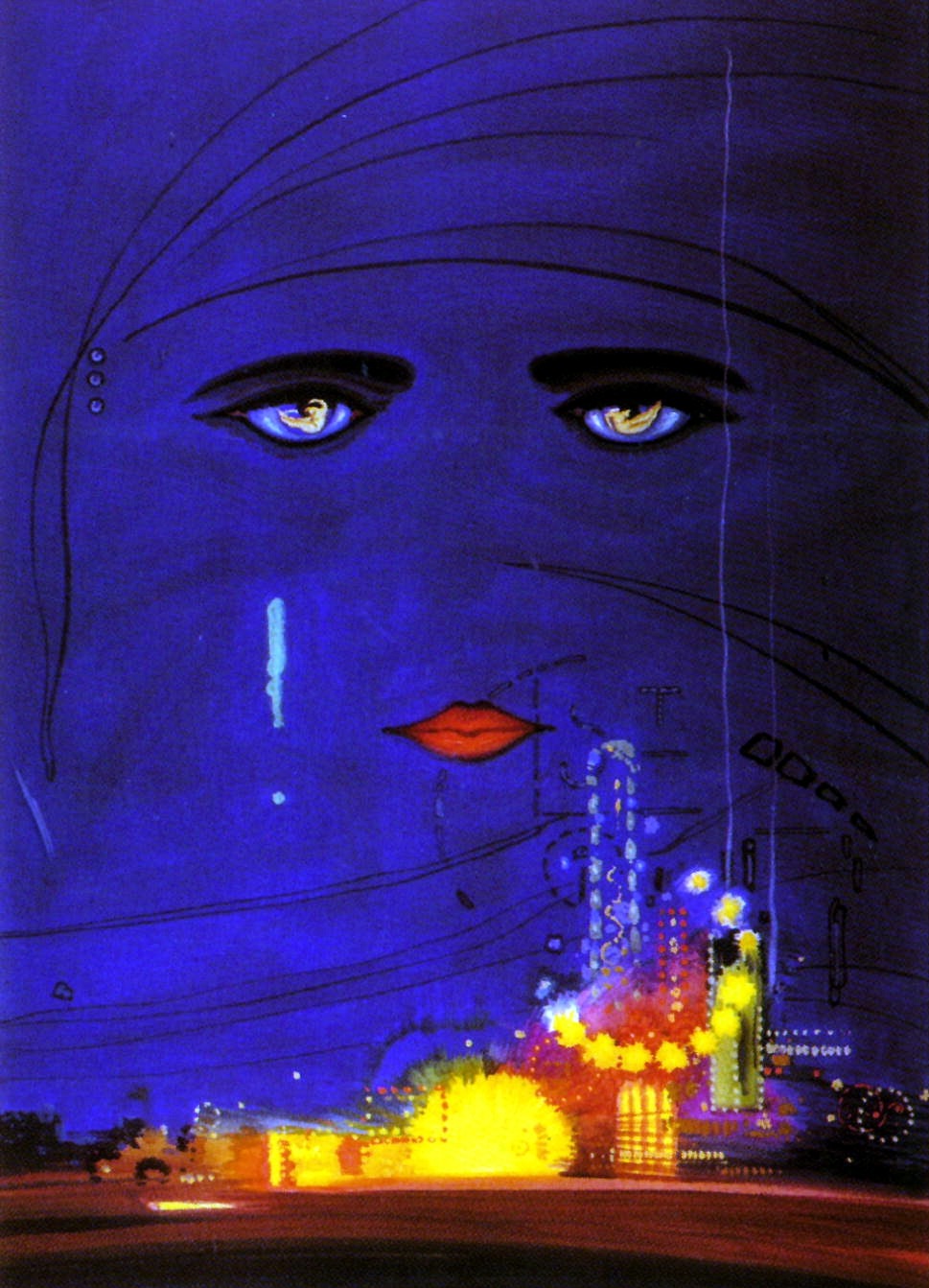
If the only book that F. Scott Fitzgerald had ever written was The Great Gatsby, he would still be one of America's most famous novelist.  It is undoubtedly his magnum opus and is consistently ranked among the greatest works of American literature.  In many ways it captures a moment in time, and in others it is a mirror reflecting not only its own generation, but that of every generation before and since.

The Plot:

It is the summer of 1922 and our narrator, Nick Carraway, has left his Midwestern hometown for a job in New York City.  He rents a house on Long Island, across the bay from his cousin Daisy Buchanan and her husband, Tom.  It isn't long before he his pulled into their glittering world.  Tom even introduces him to his mistress, Myrtle, and he is at once shocked and intrigued by their lifestyle.  But even more intriguing is his mysterious neighbor, Jay Gatsby.  Gatsby's name is on everyone's lips, and his mansion is the home of some large and boisterous parties.  No one really knows anything about Gatsby himself, but his parties are the place to be for New York society.

One day, Nick is informed that Gatsby and Daisy had a past romantic encounter, but she married Tom while Gatsby was off to war.  Gatsby asks Nick to orchestrate a meeting between himself and Daisy.  Nick agrees, and this meeting would begin a course of events that would ultimately shatter the worlds of each of the characters.

My Review (Caution - Spoilers):

I am probably one of the few people who did not read this book in high school.  Though I was, of course, familiar with the title and it's place in American literature, I knew very little about the plot and point of the book.  But with the recent release of Baz Luhrman's new film adaptation, I figured it was a good time to become fully acquainted with this classic.

While I'm not prepared to call this the greatest work of American literature (it didn't really beat To Kill a Mockingbird in my mind), it certainly deserves it's ranking near the top.  Fitzgerald's writing is simply incredible.  There are so many quotes that jump out and grab you; moments and thoughts that are beautifully captured in words.  Phrases like "Her voice is full of money..." and "So we drove on toward death through the cooling twilight." just make you stop in your tracks.  His words can't just be breezed through.  They have to be savored and mulled over.  Half the beauty of this book is found in the sentences that Fitzgerald created.

The other half is found in the intense symbolism found here.  There is lots of it and no way I can talk about all of it in this one review.  While much of the symbolism continues to speak to our modern world (like the elusiveness of the American Dream), ultimately this story encapsulates the world of the Roaring 20s.  Like Gatsby, much of the world had an almost innocent quality until the early part of 20th century.  After spending the years of World War I fighting, serving, and dying, we wanted to re-claim that innocence.  We partied, drank, and spent money lavishly in order to recapture that carefree and happy lifestyle of years gone by.  But the death and destruction had changed us forever.  No matter how much we loved, drank, or spent there was just no going back.

Ultimately, there is nothing that I can say in this review that hasn't been said before.  If you'd like to see an insightful (and funny) review, check out John Green's.  Though it isn't necessarily a book that you will "connect with" or love, it is a book that must be read.  It certainly deserves it's place among the great works of American literature.

The Movie:

There are two main film versions of this film.  The first is the 1974 adaptation starring Robert Redford and Mia Farrow.  I have not seen this version, but I know many people who really like it.  Many also consider it to be the definitive version.

The other is this year's adaptation starring Leonardo DiCaprio, Carey Mulligan, and Tobey Maguire.  This film got a lot of mixed reviews, but I actually liked it.  Was it flashy and over the top?  Sure, but isn't that exactly the kind of world Fitzgerald is describing?  I thought that DiCaprio's portrayal of the beautiful, hopeful Gatsby was wonderful and (like the story) achingly beautiful.  Mulligan also turned in a fantastic performance as the spoiled yet emotionally damaged Daisy.  As far as the modern soundtrack, I though that was a bold decision that helped connect the story with our own time.  If you are a diehard fan of the book, I'm sure you can find all kinds of little things that didn't seem to fit.  But to this first time reader, it brought all of the color, drama, and heartache of the book to life in a very vivid way.  Halfway through I was already dreading the end that I knew was coming.  I think it is definitely worth seeing.         

Wednesday, June 26, 2013

Possession

There are things that happen and leave no discernible trace, are not spoken or written of, though it would be very wrong to say that subsequent events go on indifferently, all the same, as though such things had never been.

Ever since it's publication in 1990, A. S. Byatt's novel Possession has garnerd much acclaim.  It received the Booker Prize, and was included on TIME Magazine's "TIME 100 Best English-language Novels from 1923-2005" list.  Part historical fiction, part contemporary novel, it explores the worlds of Victorian literature, academic research, and relations between men and women.

The Plot:

Roland Mitchell is an obscure scholar studying the writings and life of the manly Victorian nature poet Randolph Henry Ash.  A chance discovery in the London Library puts Roland on the scent of a possible relationship between Ash and another Victorian poet, the reclusive feminist Christabel LaMotte.  Needing more information on LaMotte, Roland looks up Maud Bailey, a descendent of LaMotte's niece and a scholar of her works.

Though Maud is initially resistant to Roland's theories surrounding a possible romance between the two poets, she finds herself drawn deeper into the mystery with him.  Their search takes them from the heart of the English countryside to the wild shores of Brittney.  It isn't long before other academics begin to sense that an earth-shattering discovery is about to be made and soon the race is on to discover the truth and claim a piece of history for their own.

My Review (Caution - Spoilers):

I discovered this novel after seeing the film version.  I found the story intriguing and wanted to find out more about the original.  The story remains intriguing in the book, but of course the depth is much greater and Byatt explores many different themes.

As the title suggests, the main theme surrounding this story is the idea of possession.  Roland and Maud's whole search is based on them possessing the knowledge of Ash and LaMotte's relationship, and yet they themselves are possessed by the search itself.  The relations between lovers become complicated as each one tries to fully possess the other.  And the various academics are most concerned with who will end up possessing the various documents relating to this discovery.  The depth to which Byatt plays on this theme is incredible.  It becomes obvious almost from the beginning that she is a very intelligent writer.  Not only does she have to create the two parallel stories of Roland/Maud and Ash/LaMotte, but she is also responsible for the dozens of Victorian-style poems found throughout the novel.  Her understanding of modern academia is also an incredible thing to read.

And yet for me, it was this very intelligence that became my downfall.  To truly appreciate this novel, I think you have to possess a Ph. D. in either Victorian poetry or creative writing.  There are entire chapters consisting of nothing but poems in the high Victorian style.  And while it is important to read them so that you can fully grasp the meaning of later chapters, it is quite a chore.  On top of that you have academics having long discussions about the poetry, long discussions about sexuality and feminism, and long discussions about the academic world itself.  I often found myself bogged down in topics that I had no real interest in with no desire except to just get back to the story.  On the surface it was something I should have loved, but it had such a heavy tone that it times it nearly overwhelmed me.

There are plenty of people who love this novel and it is REALLY well written, so I am in no way trying to discourage you from reading this.  Just be prepared for a very intellectual novel with lots and lots of poetry.  Not a horrible book, just not entirely my cup of tea.  Maybe one day when I'm smarter I'll find time to give it another try.

The Movie:

The 2002 film version stars Aaron Eckhart as Roland, Gwyneth Paltrow as Maud, Jeremy Northam as Ash, and Jennifer Ehle as LaMotte.  Obviously it is a very simplified version of the book with much of the focus staying on the various romances and the thrill of the search.  I enjoyed the film, especially the parts involving Ash and LaMotte.

Trivia: This film reunites Paltrow and Northam who previously starred together in the film adaptation of Emma.  May I say it was also interesting to see Mr. Knightley (Northam) get it on with Elizabeth Bennet (Ehle).  

Sunday, May 26, 2013

Mary Anne

She thought of her vestal virgins in Boulogne and George in his regimentals, stiff and pompous, and suddenly none of them mattered, not even George; she was home where she belonged, in the heart of London.

In 1954, British author Daphne du Maurier turned from her Gothic romances like Rebecca and My Cousin Rachel and instead wrote a fictionalized account of her great-great-grandmother.  She tells of political intrigue, scandal, and revenge during the Napoleonic wars.  But more than anything she tells the story of a woman who overcomes her poor Cockney upbringing to find herself holding power over some of Britain's most influential men.

The Plot:

Born into a poor London family, Mary Anne Thompson grows up having to use her quick wit and feminine charms to keep her family off of the streets.  At a young age she impetuously marries Joseph Clarke who ends up being a gambling alcolholic with no sense of duty to his family.  Disgusted and desperate to keep her family fed, Mary Anne leaves Joseph and supports them all be "entertaining" men of position and wealth.  Eventually, she finds herself mistress to Frederick, Duke of York and living in style.

But the Duke does not understand money and Mary Anne has a hard time keeping up with the massive debts incurred to obtain her lavish lifestyle.  With war looming and many young men eager to obtain commissions in the Army, she begins using her influence with the Duke to help get them (for a fee, of course).  All seems to be going well until the Duke tires of her.  When she finds herself on the brink of ruin, she determines that she will have her revenge on the men who have "used" her and brings about one of the largest scandals in British political history.

My Review (Caution - Spoilers):

I have been a fan of Daphne du Maurier's work for a few years now.  This story intrigued me partly for it's plot, and partly because it is based on fact and the author's own family.

As it's title says, this is Mary Anne's story.  There seem to be two sides of her that is portrayed in the novel.  The first is her indomitable spirit and her ability to play the game in a man's world.  From the beginning she is unwilling to give up.  Even when fate seems to have her beat, she goes down swinging and many times finds herself back on top.  Her family is her ultimate prize and most of what she does is to get them the best food, the best houses, and the best future that she possibly can.  But it is this very ambition that ultimately becomes her downfall.  She refuses to settle, even though she could have saved herself quite a bit of grief by knowing when to walk away.  So many times she could have had settled down and had love and basic comfort, but her desire for security drives her on and on to ruin.

While most of the right ingredients were there (interesting plot, historical fact, lively characters), du Maurier just didn't seem to be able to quite bring it all together.  The storytelling lacks the emotion of her other works, and it becomes fairly tedious at times.  Mary Anne is not an easy character to like, and thus you aren't too disappointed by her eventual fall from grace.  It isn't a bad book, it just isn't as gripping as some of her other works.

This is a book that you could take or leave.  If you are a du Maurier fan you will probably read it, just don't expect the greatness of Rebecca.  If you haven't yet read any of her works, I would not suggest you start here.  I didn't love it, but it did have some good points that made it an interesting read.      

Tuesday, April 2, 2013

The Heart is a Lonely Hunter

“The most fatal thing a man can do is try to stand alone.” 

In 1940, a novel was published that would skyrocket on the best-seller's list and eventually find itself on many "best of" lists including TIME Magazine's TIME 100 Best English-language Novels from 1923 to 2005.  Who would have expected that a story that could grip a nation like that would come from the pen of a 23 year old woman living in Charlotte, NC.  The Heart is a Lonely Hunter is the debut novel of Carson McCullers who would go on to create other works that gave a voice to the outcasts and misfits in the American south.

The Plot:

John Singer is a deaf/mute living in a small Georgia mill town in the 1930s.  He used to live with a friend and fellow deaf/mute named Spiros Antonapoulos until he was institutionalized.  Singer then rents a room from the Kelly family which brings him into contact with new acquaintances.  There's young Mick Kelly, a tomboy on the verge of womanhood who craves music and the luxury of a piano.  Jake Blount, an alcoholic and labor agitator.  Biff Brannon who owns a local diner and has a front row seat to the lives of the various townspeople.  And Dr. Benedict Copeland, an African American physician whose idealism puts him at odds with his family.  Each person comes to see Singer as a confidant who listens to and understands their deepest problems.  But will they realize that Singer has problems of his own and a desire to be understood as well?

My Review (Caution - Spoilers):

I have to say that I find it incredible that a story with this much depth and realism came from someone so young.  It certainly shows what an observant and understanding person McCullers must have been.  The way she captures the brutal reality of the Depression era south is at once beautiful and sad.

Loneliness is definitely the main theme here (though prejudice, racism, and poverty also play their part).  There is something in the life of each character that puts a barrier between them and the outside world.  Singer has a physical disability, Mick lives in poverty, Jake is drowning in alcohol, Biff works all of the time, and Dr. Copeland is a black man in a white man's world.  None of them have anyone to whom they can really bare their soul.  But each of Singer's acquaintances believes him to be the one person in the world they can talk to.  He is the one person who "listens" to what they have to say without judgement, advice, or ridicule.  Nothing but pure understanding.  But even they do not see the man inside, and they don't realize that he is crying out for the same understanding and finding none.

This is not a "fun" novel by any stretch of the imagination.  It has the brutality and grotesqueness of a Flannery O'Connor story without the grace and redemption.  None of the characters are able to break out of their loneliness and realize their dreams.  And Singer's suicide is one big punch in the gut that is certainly capable of bringing one to tears.  Like the other characters, I had grown emotionally attached to him and found his death to be shattering.

I would not say that this is a book for everyone, nor would I say that it is one I "enjoyed".  But it is certainly a classic of American literature and deserves the high praise it has received.  If you enjoy novels in the Southern Gothic tradition, or even just sad books, I suggest you give this one a try.

The Movie:

The book was made into a 1968 film starring Alan Arkin, Sondra Locke, and Cicely Tyson.  It is a good adaptation, though perhaps it has a somewhat happier ending for some of the characters.  Worth watching, with or without reading the book.