Showing posts with label Reviews. Show all posts

Wednesday, February 11, 2015

Masterpiece Theatre: Death Comes to Pemberly

Last fall, the good folks at Masterpiece Theatre treated us to a trip back to the enduringly popular world of Jane Austen.  But rather than another retelling of one of her stories, we instead enter the crazy and fun world of Austen fanfiction.  Death Comes to Pemberly was written by the late and beloved English crime writer P. D. James in 2011 and has been generally well received by Austen fans the world over.  Set six years after the end of Pride and Prejudice, the story reintroduces us to some of literature's favorite characters and imagines what life after happily ever after may have been for Mr. and Mrs. Darcy. Last year, BBC One adapted the story as a television mini-series starring Anna Maxwell Martin, Matthew Rhys, Jenna Coleman, and Matthew Goode.

I was interested (but not overly excited) in this adaptation, though I had never read the book.  I love Pride and Prejudice as much as anyone and will always welcome a chance to explore that story further.  So lets start with that aspect of the adaptation...the story.  Plot wise, this adaptation seems to connect fairly seamlessly with the original work.  The Darcys are happily married and living at Pemberly.  They have a young son, Gerogianna lives with them, and things seem to be going swimmingly.  Until, that is, a man is murdered on the estate and the prime suspect turns out to be the Darcy's brother in-law and everyone's favorite Austen baddie, George Wickham.  Now, Darcy must help the man he likes least in the world to prove his innocence (if he can) and discover the truth of what happened in Pemberly Woods.

The story is ok, nothing mind blowing.  The mystery itself was pretty basic, and I had figured out what happened pretty early on.  For me, the characters themselves were more interesting, especially the relationship between Lizzy and Darcy.  At first, I loved the idea of where the story seemed to be taking them.  As tensions increase, doubts about their own relationship creep in with Darcy wondering if Lizzy married him for his money and Lizzy wondering if Darcy secretly despises her for her family connections.  These are real, grown up problems that you know would have to come up at some point in their marriage.  But rather than allowing them to really hash these questions out and reestablish trust in each other, the story kind of lets it fizzle and they simply settle everything with some make up sex.  Personally, I would have loved to see them really get to the bottom of those doubts.

Some characters were pretty close to what you would imagine them, while others didn't seem to really jive with the Austen originals.  Anna Maxwell Martin played Lizzy as a much more somber person.  She seemed to lack the wit and vivacity that we all love in the character.  Matthew Rhys was passable as Darcy, though he didn't really inspire any passions in your heart (unless you are like me and love him simply for the sake of Rhys himself).  I was probably most confused over Col. Fitzwilliam.  The dude seemed so nice and laid back in the original novel, but here he is grumpy and self centered.  Seriously, who put his undies in a wad?  I do have to give props to Jenna Coleman and Matthew Goode who both turned in excellent performances as Lydia and George Wickham.  They were every bit as insufferable as one could hope and honestly brought the most life to their characters.

If you are looking for a story that is going to equal the magnificence of Austen's, you won't find it here.  If, however, you are ok with spending a few hours enjoying a decently acted film based around familiar and favorite characters, then you may be satisfied.  It wasn't something that I fell head over heels for, but I enjoyed myself while I watched.    

Thursday, January 15, 2015

Lila


“It felt very good to have him walking beside her. Good like rest and quiet, like something you could live without but you needed anyway. That you had to learn how to miss, and then you'd never stop missing it.”

It isn't often that contemporary literature touches my soul, but Marilynne Robinson's "Gilead" novels (Gilead and Home) have certainly done that.  When I heard that another novel set in the small Iowa town was to be released last October, I knew immediately that I would have to read it.  Not only does it take us back to a world of simple beauty and intense faith, it also provides us with the history of a woman who has lingered on the edge the story and only hinted at her true depth of character.

The Plot:

This is the story of Lila, the wife of Reverand John Ames whose story is told in Gilead.  As a young child, she was taken away from a neglectful home by a drifter named Doll.  Raised on the road, in constant search of work, shelter, and food, Lila's childhood and youth was rough and broken yet there were many good/happy memories as well.

After Lila becomes and adult and she and Doll are separated, she finds herself in even darker circumstances.  Hell bent on escaping it, Lila leaves St. Louis and eventually finds herself on the outskirts of the small Iowa town of Gilead.  It is there that she meets Rev. Ames, who seems to offer her a chance at peace, safety, and love.  But trust has never been a luxury that Lila could afford, and not a day goes by that she doesn't have to choose between staying in the quiet town or searching for freedom out on the road.

My Review (Caution - Spoilers):

Ever since I read Gilead, I have been dying to know more about Lila.  She played an interesting role in both of Robinson's novels whether it was her quiet devotion to Rev. Ames or the sympathy she seemed to have with Jack Boughton.  I think Robinson satisfied every longing I had with this one.

I have always delighted in how Robinson portrays the beauty of grace and the Christian faith.  As with the other two novels, we get to see grace played out in the life of one of the characters, but in a completely different way.  Rev. Ames is the man who has been secure in his faith for a long time, Jack Boughton is the man who is running from the faith of his father, and Lila discovers grace for the first time and slowly learns to embrace it.  She is someone who has never been offered true rest, quiet, and safety.  Rev. Ames offers it to her, demanding no explanations, no guarantees, and no apologies.  I think it is a beautiful picture of the life that Christ offers us.  He gives us love and grace regardless of our past.

But though Robinson portrays the beauty of God's grace, she doesn't ignore the difficulties we can have with reconciling our faith with our lives.  Though her childhood was by no means easy, it is obvious that Lila has a deep affection for the people she knew in her youth.  As she learns more about Rev. Ames' faith, she learns that her friends may not have been "saved" and this is something she can't bear to think about.  Trying to balance what we believe with what we actually experience in life is quite possibly the hardest part of being a Christian.  Robinson does a wonderful job of showing us that we can allow ourselves to question our faith.  To not shy away from the hard questions but to ask them and wrestle with them.

As always, Robinson's prose is simply stunning.  I will say that the format of this book took some getting used too.  Rather than being a letter or novel by an educated person, it is the disjointed thoughts and feelings of a woman who has not received as much education.  Time skips around and events don't really follow each other like normal.  But it makes sense for the character and becomes easier to follow as you go along.

This is certainly a fitting addition to the "Gilead" series.  Though I think I will always love and identify with Gilead the most, the raw beauty of this one touched me and dealt with a lot of my own thoughts and struggles from the past couple of years.  Do yourself a favor and pick this one up.      

Thursday, January 1, 2015

Welcome 2015

I say it ever year, but I can't believe we are entering a brand new year.  It seems like only yesterday I was making plans for what to read in 2014.  I had an excellent year in reading, though I'm afraid my posting over the last few months may not reflect it.  I read 26 books in all and completed 2 challenges (Back to the Classics 2014 and the 2014 Shakespeare Reading Challenge).  Here is a ranking of my favorite reads for 2014:

Honorable Mention: Tess of the d'Urbervilles by Thomas Hardy.  This is a story that touches you to your core.  Tess Durbeyfield is probably the most real character in all of the stories I read this year.  She is sad, beautiful, strong, vulnerable, and brave.  She is a victim of her times and yet in the end she manages to rise above it all.  This isn't a story that will leave you smiling, but it also won't leave you the same.

#5: Night by Elie Wiesel.  This is another story that will change you.  Wiesel's account of his family's experience in the Holocaust is painful, horrifying, and raw.  Watching these people be systematically stripped of their humanity is difficult, but it is necessary.  The ultimate tragedy would be for us to turn away from theses victims' stories and to forget what atrocities the human race is capable of.

#4: And Then There Were None by Agatha Christie.  This was my second Agatha Christie novel and there is no disputing that she is one of the best (if not the best) crime writer ever.  While the stories happen in the most peaceful and idyllic of settings, they are filled with a suspense that is almost palpable.  This particular story is fast paced and intriguing, and the ending (though a little convenient) is one you won't see coming.

#3: The Black Count by Tom Reiss.  This story of Alexandre Dumas' father and the inspiration for characters like the Count of Monte Cristo was spectacular.  I was hooked from the very beginning and I learned so much.  It covers not only the story of General Dumas' life, but also slavery and race relations in 18th century France as well as one of the best overall accounts of the French Revolution that I have ever read.  It's a shame that it took so long for this story to be told.

#2: Richard III by William Shakespeare.  Of all of the Shakespeare plays that I have read, this one stands out as my overall favorite.  It has a gripping story, immortal lines, and one of literature's best non-heroes.  Richard is one of the most intriguing characters I have ever come across and you can certainly see his influence in our own modern storytelling.  If you don't read any other Shakespeare history play, make it this one.

#1: Lila by Marilynne Robinson.  Of all of the modern writers that I have read, none has touched me quite like Marilynne Robinson.  This is the third book in her Gilead series and it was everything that I hoped it would be.  We get a look at the past of the series' most intriguing character, and we see how love and grace given freely can change a person's life forever.

Yes, 2014 was a terrific year in my reading life and I am so excited for what I'm going to read in 2015.  Here is a look at what I have planned for the first part of this year:

- Nicholas Nickleby by Charles Dickens
- A Moveable Feast by Earnest Hemingway
- Howard's End is on the Landing by Susan Hill
- Dr. Zhivago by Boris Pasternak
- The Dogs of Riga by Henning Mankell
- Unbroken by Laura Hillenbrand
- A Passage to India by E. M. Forster
- Stardust by Neil Gaiman
- The Hitchhikers Guide to the Galaxy by Douglas Adams

What was your favorite read of 2014?  What big plans do you have for 2015?  Share with us.  And happy New Year!
        

Tuesday, December 9, 2014

Mary Barton


“There is always a pleasure in unravelling a mystery, in catching at the gossamer clue which will guide to certainty.” 

As most people know, the Victorian era was a time of great change in the Western world.  It was a time of invention, of industry, of power, and of great wealth.  It was also a time of social upheaval, of intense poverty, and of class division.  And while our minds might immediately envision the narrow, dirty streets of Dickens' London, another author asked us to turn our eyes to the north and see the squalor, the heartbreak, and the division that was eating away at the heart of England's manufacturing district.

The Plot:

Mary Barton is the only living child of John Barton, a mill worker in Manchester.  Her mother died when Mary was young and her father blames her death on the sudden disappearance of his sister-in-law, Esther.  John is heavily involved in the trades union in Manchester and has become more and more depressed over time as the industry has hit a rough patch and paying jobs are scarce.  Mary takes a job at a dressmakers and to help support herself and her father.  

Mary's long-time friend, Jem Wilson, has loved her for years but is turned down when he proposes.  Mary has her sights set higher and is enjoying the secret admiration of Harry Carson, the son of a prominent mill owner.  But when Harry is murdered and Jem is arrested for it, Mary realizes where her affections truly lie and she sets out to do everything in her power to save the man she loves.

My Review (Caution - Spoilers):

The first novel by Elizabeth Gaskell that I read was North and South, which I absolutely loved.  I was pretty excited to read this novel, which was her first.  Though this one didn't affect me the way that one did, it is still a solid read.

It's neat to see a female Victorian author take on the issues of social justice and economic inequality as passionately as some of the male authors (like Dickens and Trollope).  Gaskell comes out swinging, showing us the abject squalor that was the reality for so many people of that time.  And while she doesn't blame the mill owners and wealthy for the economic situation that is causing it, she does fault them for refusing to see and help the needy people all around them.  John Barton goes to extremes in his retaliation, but one can imagine the desperation one might be driven to if you watch others live in lavish comfort when your own friends and loved ones are dying.  It was also interesting to see the geographical disconnect between London and Manchester.  Even today, it is easy for those who live in the seat of power to simply turn a blind eye to the needs of those who live further away.

While the social aspect of this story is as solid as that of North and South, the narrative is not.  It is harder to connect to these characters the way we do Margaret Hale and John Thornton.  Mary comes off as rather flighty and seems to have less spirit than Margaret.  And while Jem is a sweet guy, he lacks that quality of strength and passion that John Thornton embodies.  As a whole, the narrative seems less tight and comes off as rather heavy handed at times.

This is certainly a solid read and a must for anyone who loves Gaskell or Victorian lit.  If you are new to Gaskell's works, however, I would suggest you start with North and South.  You'll get the same social message with a better story and stronger characters.      

Monday, December 1, 2014

The Phantom of the Opera

“If I am the phantom, it is because man's hatred has made me so. If I am to be saved it is because your love redeems me.” 

In 1910, French writer Gaston Leroux published a novel that drew from his time covering the Paris Opera as a reporter.  Based on actual historical events at the opera, his story would go on to be the basis for many adaptations.  The story was finally immortalized by the 1986 Andrew Lloyd Webber musical which is the longest running musical in Broadway history.

The Plot:

In the light and glitter of 19th century Paris, the Paris Opera has come under new management.  The managers are told of a phantom who haunts the opera and demands payments, a private box, and other things in exchange for keeping the opera safe from himself.  The new managers scoff at such a notion and begin to ignore the Phantom's wishes one by one.  It isn't long before mysterious things begin to happen in the vast opera house.

One of these is the rapid rise to stardom of a chorus girl named Christine Daae.  She is convinced that her dead father has sent the "Angel of Music" to help teach her as he once promised.  She becomes reacquainted with her childhood friend, Raoul, and tells him of her "angel" expressing both intense fear for it as well as passion.  Raoul is convinced that Christine is being held against her will in the power of an all too real man, and he sets out to discover the true identity of his rival.

My Review (Caution - Spoilers):

Like most people, I first became aware of this story through the famous musical.  I like many aspects of the musical, though there is an element to Erik's obsession with Christine that is a little too creepy for me.  Still, I knew that many fans liked the book so I thought I would give it a try.

My overall opinion?  I wasn't too impressed.  This is a tricky story and I only see a couple of ways to really make it work.  The first is to read it as a sensation story.  Leroux's original readers would have been familiar with the historical context of the novel, and it obvious the Leroux was playing this up for sensation.  The whole story is played out like a mystery, as the identity and methods of the Phantom are slowly revealed.  You can certainly see the elements of Leroux's other writings which included detective fiction and "locked room" mysteries.  This is all well and good if you are new to the story.  Unfortunately, most of today's readers are not.  There is very little room for discovery and surprise since we already know the Phantom's identity, past, motivations, and his fate.  This takes a lot of the "sensation" out of the story.

The other way to make this work is to fill the story with something other than sensation...something like pity.  The reason the musical connects to so many people is that it does a good job of making you feel a strong amount of pity for the Phantom.  He is turned into this romantic anti-hero who needs only the love of a woman to make him a good man.  The book fails to do this.  Because Leroux is setting up an atmosphere of horror and suspense, he tends to play up the dark side of the Phantom.  Though there are small shots of sympathy here and there, we are never allowed to see things from the Phantom's point of view so it is difficult to see beyond his actions and his ugliness.  

If you are a huge fan of the musical, then you will probably want to read this for more background and context.  For everyone else who may be a casual fan (or not one at all).  I'm not sure I can wholeheartedly recommend it.  It just didn't excite me very much.

The Movie:

I have seen two versions of this story.  One is the 2011 live production of the musical at the Royal Albert Hall starring Ramin Karimloo and Sierra Boggess.  I liked this production and it was nice to have the opportunity to see the actual musical.

The other is the 2004 film version starring Gerard Butler and Emmy Rossum.  I didn't hate it, but it didn't really become a favorite either.  The one decent aspect was Gerard Butler...didn't mind having him sing to me for a couple of hours! 

Sunday, November 23, 2014

Page to Screen: Enchanted April

In 1991, director Mike Newell brought Elizabeth von Arnim's 1922 novel The Enchanted April to life.  With a solid cast, slow pace, and stunning scenery, it is an enchanting little film and one that is sure to help put a bit of calm into a stressful life.

The four main female characters are portrayed by Josie Lawrence (Mrs. Wilkins), Miranda Richardson (Mrs. Arbuthnot), Polly Walker (Lady Caroline Dester), and Joan Plowright (Mrs. Fisher).  The men of the novel are played by Alfred Molina (Mr. Wilkins), Jim Broadbent (Mr. Arbuthnot), and Michael Kitchen (Mr. Briggs).  I thought the entire cast was simply marvelous.  Of course, the performances themselves were solid but it was also nice to see the characters brought to life just as I imagined them when I was reading the book.

The film also did a fantastic job keeping the plot and pacing of the book intact.  When a book has as slow a pace as this one, it is easy for the film to try and add lots of extra drama, etc. to make up for it.  That doesn't happen here.  Instead, the film embraces the quietness and self-reflection of the novel and allows the story to simply be about the characters themselves.  Couple this with some spectacular scenery and you have a film that feels like a quiet vacation in and of itself.

If you like the book, this is a wonderful adaptation.  True to the story and characters, beautifully shot, and nicely paced, it is a little gem.  I recommend it for anyone who enjoyed (or is even interested in) the book.  

Monday, November 17, 2014

The Enchanted April

“Now she had taken off her goodness and left it behind her like a heap of rain-sodden clothes, and she only felt joy.” 

It is so easy to get bogged down in our lives.  To wake up one day and realize that we don't like where we are or what we have become because of it.  In her 1922 novel, Elizabeth von Arnim tells the story of four unlikely travel companions who leave their dreary lives behind and find joy, friendship, and love on the shores of Italy.

The Plot:

Lottie Wilkins needs a change.  She isn't sure whether her unhappiness is due to her own timidity, her husband's attitude towards her, or the dreary English weather.  Whatever the reason, once she reads the advertisement for a secluded castle on the Italian coast to let for the month of April, she knows she has to go.  She also notices that a slight acquaintance in her women's club,  Rose Arbuthnot, has seen the advertisement and she impulsively enlists her as a traveling companion.  Before they know it, the two have made the arrangements to rent the castle and have also found two more companions, Mrs. Fisher and Lady Caroline Dester, to help split the costs.

Each woman declares that they simply mean to get away from it all and be alone.  They have little intention of being near each other except at mealtimes, and true friendship certainly seems out of the realm of possibility.  But Italy has other plans.  As the month passes, the atmosphere of San Salvatore works its magic on each woman.  They slowly open up to each other, and in the end find themselves longing for the very things (and people) they were trying so desperately to escape.

My Review (Caution - Spoilers):

This book has been on my "to read" list for awhile now and it was nice to finally get around to it.  Though it was not all together what I was expecting, it was still a nice little read.

Though at first it seems that all four women are nothing but drab and unhappy women with a great need to escape the dreary English weather, it soon becomes apparent that they are actually lively and unique individuals.  Each woman has shut herself off from her world for different reasons.  Lottie feels that she can't please her husband.  Rose is embarrassed by the way her husband makes a living (writing books about royal sex scandals).  Lady Caroline can't stand being constantly followed around by men struck by her beauty.  And Mrs. Fisher simply won't let go of the past.  But as they spend more time in Italy, and each other's company, they begin to break down the walls they had constructed and allow themselves to be open to each other.  I think we've all at one time or another simply been simply shut away inside ourselves.  Sometimes, we don't even realize we are doing it.  We simply know that our relationships with others aren't very strong and we find no joy or satisfaction in what we should love.  We can't all rent a castle in Italy for a month, but we should stop periodically and evaluate what needs to change in our lives (and ourselves) to allow us to be open with the ones we love.

Though the setting of the book is certainly beautiful (lots of flowers, a spacious castle, ocean views), I was slightly disappointed that the book didn't really allow for Italy to be a character.  The only Italians we meet are the servants and none of the visitors ventured outside of the castle grounds.  I was hoping for something along the lines of A Room With A View and an "Italian flavor" to the story. This story, though charming, could have happened in any beautiful place.

This book certainly has it's charming moments and is a great story of the need for openness in any relationship.  Though I wasn't quite satisfied with the lack of, well, Italy in this novel it is still one that I can recommend.  An easy read with lots of lovely little lines and moments.

The Movie:

I will fully review the 1992 film version of this book in a separate post.    

Saturday, October 25, 2014

Eugene Onegin


“My dreams, my dreams! What has become of their sweetness? What indeed has become of my youth?”

When we think of Russian literature, names like Tolstoy, Dostoevsky, Gorky, and Solzhenitsyn are the most likely to come to our minds.  But the tradition of modern Russian literature began several decades before the works of these great authors.  It began in the early 19th century with the works of Alexander Pushkin whom many believe to be not only the father of modern Russian literature, but also Russia's greatest poet.  His serialized "novel in verse" Eugene Onegin first appeared in 1825 and it's well loved characters and story would gain immortality as an opera by Tchaikovsky.

The Plot:

Eugene Onegin is a young St. Petersburg socialite who has become bored with his life which consists of nothing but balls and parties.  When he inherits a landed estate from his uncle, Onegin seeks a change by moving to the country.  There he meets his neighbor, a dreamy poet named Vladimir Lensky.  Lensky offers to introduce Onegin to the other area families, including that of his fiancee, Olga Larina.  Olga's sister, the quiet and romantic Tatyana, is immediately taken with Onegin and develops an intense (though rather naive) passion for him.  

When she can no longer suffer in silence, Tatyana openly declares her love to Onegin in the form of a letter.  Onegin coldly crushes her dreams and suggests she learn to control her emotions.  Not long after, Onegin's thoughtlessness leads to a misunderstanding with his friend, Lensky, and the ensuing tragedy will change everyone's life forever.

My Review (Caution - Spoilers):

I was first introduced to Alexander Pushkin through the Great Courses lecture series on the Classics of Russian Literature that I listened to.  I fell in love with his poetry and the plot of this story intrigued me, so I knew that I would have to read it one day.

This is truly a novel in verse and is about 389 stanzas in length.  It took awhile to get used to the rhythm of the poetry (like a Shakespeare play), but once that is done it flowed very smoothly.  It is also a little slow to start as the narrator spends a lot of time introducing the character of Onegin, discussing Russian society and the differences between country and city life, and reflections on his own muse.  But once the actual story gets going, it is rather enthralling.  In many ways, the poetry allows Pushkin to infuse the story with real emotion.  This is a story whose plot is less driven by action and more driven by the intense emotions of the characters.

The two characters whose emotions chiefly drive the plot are Onegin and Tatyana.  Onegin is consumed with an ennui that affect every aspect of his life.  Though he is included in social gatherings both in St. Petersburg and the countryside, he finds no real pleasure in them.  His pride and selfishness keep him at a distance from people, and make him unable to feel true sympathy with others.  This ultimately leads to the death of his only friend.  To Pushkin, Onegin represents everything that is wrong with Russia's high society.  Tatyana, on the other hand, is everything that Onegin is not.  She possess an inner strength and true compassion for others.  Though quiet, she is consumed with an intense passion.  Her declaration of love to Onegin is powerful, especially for a young woman in the 19th century.  And Pushkin doesn't fault her for this openness, but rather faults Onegin for his cruelty.  Tatyana is the Russia that Pushkin admires.  Unfortunately, society continues its work in the lives of both characters and by the time Onegin expresses his sincere love for Tatyana and remorse for his actions, she has armed herself against feeling and crushes him in return.

The difficulty in effectively translating Pushkin's works into English means that he is not generally well known to Western readers.  This is a real shame because the works I have read have been so full of passion and human emotion.  Though it lacks the epic scope of what we now consider to be real Russian literature, it makes up for that with intense feeling and a fascinating glimpse of early 19th century Russia.  I recommend it to anyone who enjoys romantic poetry, or Russian literature in general.

The Movie:

This story was most famously adapted as an opera by Tchaikovsky in 1879 and continues to be performed around the world.  I hope to find a good recording of it and watch it soon.

There is also a 1999 film version called Onegin starring Ralph Fiennes, Liv Tyler, and Toby Stephens.  I thought it was a wonderful adaptation that really captured the emotion of the original.  Worth a watch whether or not you have read it.    

Thursday, October 16, 2014

Dragonwyck

He was all sin and mystery, and Miranda feared the pleasures he offered as she feared the fires of hell. Yet when she succumbed at last, it was not because her body was weak but because her mind was curious.

Beginning in the 1940s, American author Anya Seton began writing historical romances.  Her subjects ranged from Katherine, the wife of John of Gaunt to Elizabeth Fones, niece to the first governor of the Massachusetts Bay Colony.  Her works would go on to influence many later writers, including Phillipa Gregory.  Her 1944 novel Dragonwyck is set a hundred years earlier when a still young American nation was trying to determine exactly what constituted true freedom.

The Plot:

Miranda Wells is a young woman who has spent her entire life on the family farm in the Hudson River Valley of New York.  She chafes at her family's humble life and yearns to find adventure outside of the farming community.  She gets her chance when her mother receives a letter from a distant relation, Nicholas Van Ryn, who asks that one of her daughters come and live at the family estate known as Dragonwyck and become a governess for his daughter, Katrine.  Miranda gleefully accepts and is soon taken with the handsome and cultured Mr. Van Ryn, though his wife is anything but welcoming.

Life at Dragonwyck is different from anything Miranda could have expected.  Not only is she out of her depth in this grand society, but there is also a dark and mysterious presence that seems to haunt the house.  When tragedy makes a way for Miranda to attain the life she has always dreamed of, she finds that neither Nicholas nor Dragonwyck are truly what they seem.

My Review (Caution - Spoilers):

This is just one of those books that rings all of my bells.  Historic setting...check.   Mysterious house with a Gothic touch...check.  A magnetic and dangerous love interest...check.  Though it isn't great literature in the way a Bronte novel is, it was still very enjoyable.  It reminded me a lot of Daphne du Maurier's works.

The historical setting for this was very fascinating.  I had no idea that there was an almost feudal land system in America until I was introduced to this story.  This system was left over from the Dutch settlers of early New York and forced the tenants to pay the "patroon" in goods and services.  It is against this dying system that Seton sets her story.  Like the plantation owners of the South, Nicholas refuses to believe that his way of life will ever come to an end and he cannot understand why his tenants would want the change.  Seton doesn't just use historical settings in her novels, but also historical figures.  Writers like Edgar Allen Poe and James Fenimore Cooper make appearances in the story without it a jarring effect on the reader.

Though we see everything through Miranda's eyes, it is Nicholas who drives the story.  His personality is forceful and magnetic, and though you are never able to come to love him like you would Mr. Rochester or Maxim de Winter, you can't hep but be interested in him.  It is pretty obvious from the beginning that his relationship with Miranda has all the marks of an abusive one.  Nicholas is the type of person who believes that he can have anything he wants by sheer willpower.  But fate is the ultimate master and Nicholas must watch as the things he values most in his life are taken from him one by one.

As I said, this book had so many of things I love in my reading life.  If you are someone who likes historical romances or Gothic stories, this one is for you.  It has some fascinating aspects that will make it hard to put down.

The Movie:

I was introduced to this story by the 1946 film starring Gene Tierney, Vincent Price, Walter Huston, and Anne Revere.  It follows the book pretty well though it does end differently.  Vincent Price is simply masterful as the polished yet ruthless Van Ryn.  Great for classic film fans even if you don't read the book.

Saturday, October 4, 2014

Catherine the Great: Portrait of a Woman

I have always been intrigued by Russia.  It is a country and a culture that is at once familiar and yet so very different from our own.  It is a country shaped by the weather, by religion, and by it's size.  It has also been shaped by its many rulers from Tsars to communists.  But perhaps no one other than Peter the Great has left as big a mark on Russian history as Empress Catherine II.  In his 2011 biography of her, historian Robert K. Massie explores the life of one of history's most remarkable women and how she overcame so many obstacles to lead her nation into a new era.

I had been wanting to read this book for awhile and ended up enjoying it quite a bit.  I had only a vague knowledge of Catherine and the role that she played in Russian history.  Massie recounts Catherine's entire history from just before her birth in 1729 to her death in 1796.  Many factors lead Catherine from a small Prussian province to the throne of one of Europe's mightiest empires.  She was cousin to the prospective tsar, Peter of Holstein, and was considered a good match by those who wanted Russia to trade its alliance with Austria for an alliance with Prussia.  But though life in the Russian court was glittering, it was not without its downsides.  She was subject to the whims and ever changing moods of Empress Elizabeth.  Her husband was an overgrown child with no sense of dignity and no love for his wife.  And like all royal courts, this one was full of spies and people seeking to climb the ladder of success.  But Catherine's intelligence, wit, and beauty charmed many people and eventually she found herself on the throne and loved by the people she had adopted as her own.

Catherine's life was simply fascinating.  One of the most interesting aspects was how much she was a product of the times she was living in.  From a young age she was caught up in the ideas of Enlightenment.  Voltaire, Diderot, and d'Alembert became not just her tutors in political thought, but her personal friends as well.  Though she eventually gave up the idea of establishing a true Enlightened monarchy in Russia, it did lead to many changes and helped usher Russia into Western society.  Social changes were begun during Catherine's reign, including changes to Russian law and more freedoms for the serfs.  She also encouraged arts, culture, and education throughout the empire.  This cultivation of the arts lead to the existence of many of the great Russian writers, musicians, and artists that we appreciate today.  From Pushkin to Tolstoy to Tchaikovsky, I think it is safe to say that none of them would have existed as we knew them without Catherine the Great.

For all of the accomplishments of her reign, Massie never loses sight of the fact that she was first and foremost a woman.  He shows us not only the strong and intelligent empress, but also the woman in desperate need of love and affection.  Catherine never received true love in early life.  Her mother and her husband were especially disappointing.  The rest of her life, she constantly sought the comfort of many different lovers.  Several of these men would eventually leave their mark not just on Catherine, but on Russia as a whole.  But no matter how much she loved a man, Catherine never gave up or shared her rights as empress and she always remembered the duty she had to the people of Russia.

This is a well written biography and an easy read for the layman historian.  Massie packs in a lot of information but does so in a way that is not overwhelming or "scholarly" in tone.  He also includes lots of background on Russian history and society that is helpful to those who may not have much of a background in it.  I recommend this to anyone who has an interest in Russian history, or in Catherine.  Though Massie shows her flaws, he also portrays the strength she had as a woman and a leader.  A wonderful glimpse into the life of a woman who changed not just her own nation, but the world as well. 

Saturday, September 27, 2014

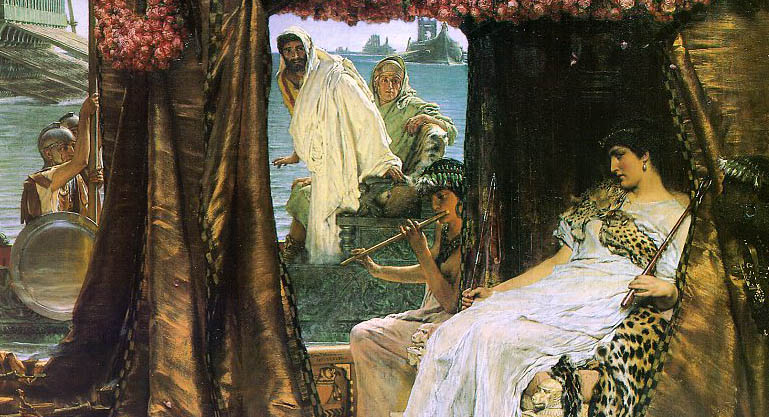
Antony and Cleopatra

"The breaking of so great a thing should make a greater crack."

Believed to have been first performed around 1607, this play immortalizes one of history's most famous and captivating love stories...that of Roman general Mark Antony and Cleopatra, Pharaoh of Egypt.  It is a story of passion, betrayal, power, and ambition.  But more than the relationship of two people is at stake as two empires collide and the fate of the world hangs in the balance.

The Plot:

Mark Antony is one of the triumvirs of the Roman Republic, but lately he has been neglecting his duties.  He has fallen in love with Cleopatra and spends his time with her in Egypt.  He ignores Rome's problems, even when his own wife dies after leading a rebellion against Octavius Caesar.  Tensions mount between Antony and Caesar when Antony is called back to Rome to help fight pirates who are terrorizing the Mediterranean.  In an effort to smooth things over and strengthen the bond between the co-rulers, newly widowed Antony marries Caesar's sister, Octavia.

Eventually, Antony is unable to resist returning to Cleopatra.  He abandons his family and has himself and Cleopatra crowned as King and Queen of the eastern third of the Roman Empire.  War is inevitable and both sides prepare for a meeting that will change not only of their own lives, but that of the empire as well.

My Review (Caution - Spoilers):

I wasn't sure what to expect from this particular play, but I ended up enjoying it quite a bit.  It was, in my opinion, the most complex of the Shakespeare plays that I have read.  I enjoyed the Roman setting, and the similarities to the power struggle seen in Macbeth was interesting as well.

The play is structured around the dichotomy of Rome and Egypt.  Rome is portrayed as an almost masculine empire.  It is ruled by men and governed by law and reason.  Honor and strength in battle is considered more important than anything.  Egypt, ruled be a woman, is portrayed as a land of pleasure and sensuality.  Emotion dictates action.  In this world, there is no room for emotion and reason to coexist.  Antony is weak because he allows his desire for Cleopatra to keep him from fulfilling his duties to Rome and to his family.  Though it is line with 17th century thinking, it could certainly rub modern audiances the wrong way.

The role of Cleopatra is considered by many one of Shakespeare's most complex female roles.  At first glance, she seems to embody the manipulative seductress.  She is given to hysterics, uses her changing moods to keep Antony with her, and rules a court given completely to pleasure and sensuality.  And yet, underneath all of that, she is also a skilled ruler.  She shows time and again that she does not use her feminine whiles for selfish pleasure only.  She is Julius Caesar's mistress while he is in power.  She saves her Egyptian fleet at the price of Antony's.  She considers Octavius Caesar's offer of allowing her to keep Egypt in exchange for killing Antony.  And she takes her own life, not in grief for Antony, but rather in fear that she will be taken to Rome as a prize.  It is clear that she is not a character to be put in a box.

This was a nice way to finish my summer reading of Shakespeare.  It is certainly not as cut and dry of a play as it may appear at first glance.  And in many ways, it combines elements of all of the Shakespearean categories...comedy, history, and tragedy.  A good read for anyone who loves Roman history and complicated characters.

The Performance:

Though reading Shakespeare is fun, it is also important to see it performed.  Shakespeare gives few stage directions and this allows each individual give their own interpretation of the characters an their actions.

I watched the 1974 television performance by the Royal Shakespeare Company.  It stars Richard Johnson, Janet Suzman, Corin Redgrave, and Patrick Stewart.  This is the RSC, so naturally it was well acted.  Some of the production values screamed 1970s, but overall it was a good performance.

Do you have a favorite performance of this play?  Share with us in the comments!

Saturday, September 20, 2014

Henry IV, Part 2

Canst thou, O partial sleep, give thy repose
To the wet sea-boy in an hour so rude;
And in the calmest and most stillest night,
With all appliances and means to boot,
Deny it to a king? Then, happy low, lie down!
Uneasy lies the head that wears a crown.

The reign of Henry IV draws to a conclusion in the third of Shakespeare's series of history plays.  Though less known (and less loved) than Part 1, there are moments of mirth and heartbreak  that will remain with the reader (or audiance) forever.

The Plot:

Part 2 picks up right where Part 1 leaves off.  Hotspur is slain, but there are other rebellious parties that must be defeated.  Prince John of Lancaster rides to the north to engage the armies of the Archbishop of York.  Sir John Falstaff makes his way, slowly, behind him gathering men for the royal forces along the way.  Prince Hal seems to slip back into his old habits and company, again grieving his father.  And King Henry IV is weighed down by his crown and feels he is reaching the end of his reign.

My Review (Caution - Spoilers):

As a follow up to Part 1, this particular play seems less dramatic and not as tightly written.  There are no battle scenes, less time is spent amongst the rebels, and Prince Hal and Falstaff only encounter each other twice.  But there were some stand out ideas and scenes that definitely stuck with me.

The first is the decline of King Henry IV.  He is a man who gained his crown through rebellion and has had to fight every moment of his reign to keep it.  His dream of leading a crusade to the Holy Land slowly fades as he realizes that his health and the rebellion in the kingdom will never allow it.  Though he gained what he wanted (the throne of England) he was never able to enjoy it in peace.  His greatest achievement became his greatest curse.  He hopes that Prince Hal will have a more peaceful reign since he will attain the crown legitimately, through inheritance.

The most important part of this play is the transformation of Prince Hal to Henry V.  At the beginning of the play, it seems that he has slipped back into his old habits.  He continues to frequent his old haunts and spend his nights in pleasure.  And yet, it becomes apparent that his perspective is changing.  As his father lies on his deathbed, he considers how much the crown cost the king and what a weight of responsibility it is.  His acceptance of this responsibility and his change in behavior is both wonderful and heartbreaking.  It was good to see him accept the Lord Chief Justice (who had openly scolded his wild behavior) as a mentor.  On the other hand, his dismissal and banishment of his former companions, including Falstaff, comes across as rather harsh.  Though we know that Falstaff is a fool and not someone who should be close to a king, it is obvious that his love for Hal is genuine.  The betrayal he felt must have been devistating.

This is probably the weakest of the Shakespeare plays I have read this summer, yet it is one that should be read along with the other three in the series.  It certainly outlines the burden that comes with power and the strength of character needed to rule wisely.

The Performance:

 Though reading Shakespeare is fun, it is also important to see it performed.  Shakespeare gives few stage directions and this allows each individual give their own interpretation of the characters an their actions.

As with Part I, I watched the 2012 production included in BBC's The Hollow Crown.  It stars Jeremy Irons, Tom Hiddleston, Simon Russell Beale, David Bamber, and Geoffrey Palmer.  It was a wonderful production that beautifully conveyed the heavy emotion of the play.  Definitely worth watching.

Do you have a favorite performance of the this play?  Share with us in the comments!       

Saturday, September 13, 2014

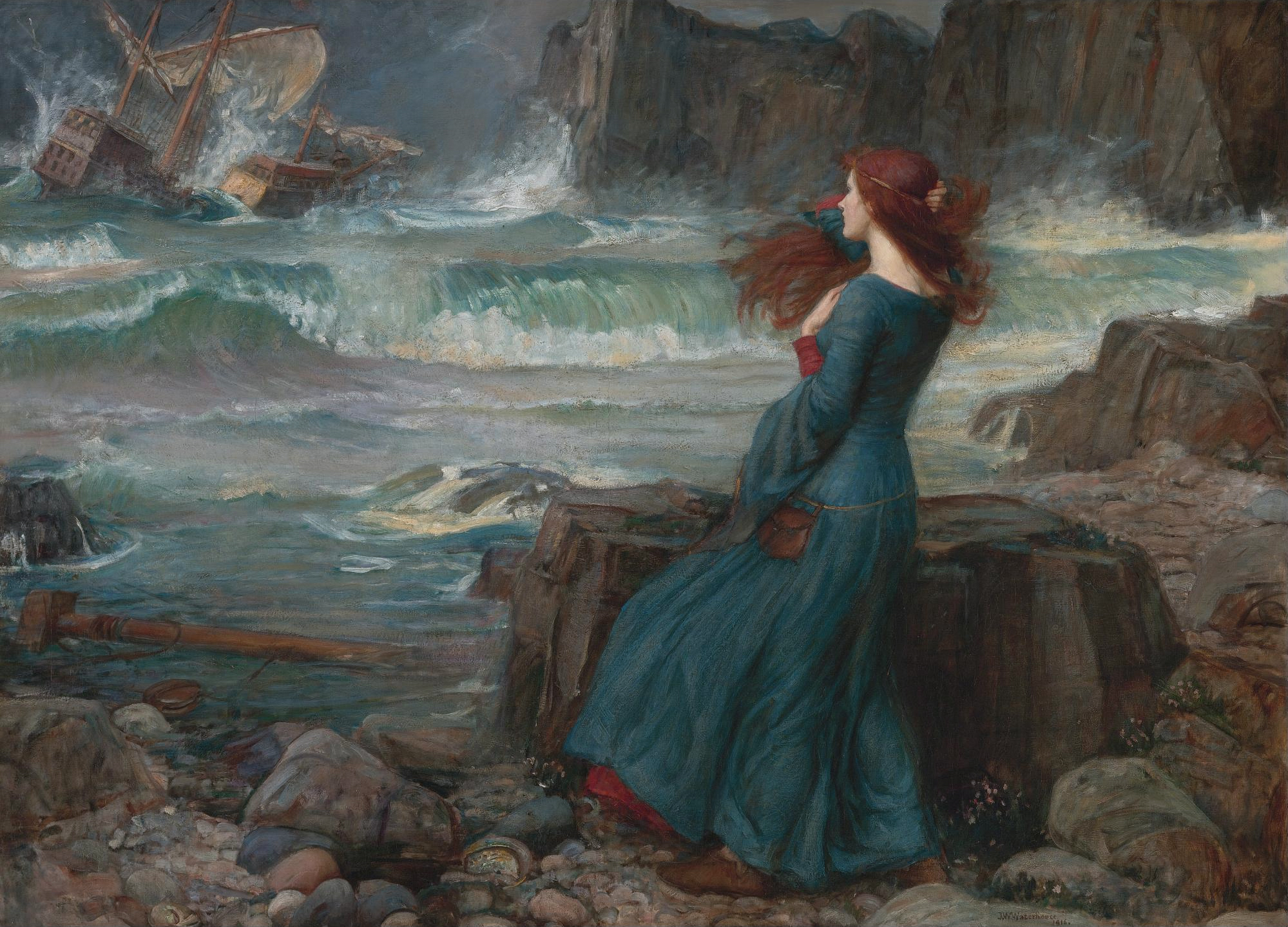
The Tempest

“We are such stuff as dreams are made on, and our little life is rounded with a sleep.” 

Supposedly written in 1610-11, The Tempest is believed by many scholars to be the last play Shakespeare wrote on his own.  Though not very popular with 17th century audiences, it is now considered by many to be one of Shakespeare's greatest works.  In some ways, this particular play is concerned with its own nature, and many early scholars have seen it as Shakepeare's farewell to the theater.  

The Plot:

After being usurped by his brother, Prospero, the rightful duke of Milan, and his daughter, Miranda, have lived for 12 years on a deserted island.  Chance brings those who had overthrown him in the vicinity of the island, and Prospero uses his magic arts to cause a storm that washes everyone ashore and scatters them about the island.  This includes his brother, Antonio, Alonso the King of Naples, and the king's son, Ferdinand.  With help of his spirit servant, Ariel, Prospero works to bring all of the company back together and reclaim his rightful place as Duke of Milan.

My Review (Caution - Spoilers):

I was pretty familiar with the plot of this play though I had never actually read it.  It has several different qualities that set it apart from the typical Shakespearean comedy.  I found it to be less laugh out loud, but rather enjoyed the more mystical aspects of it.

As with Macbeth, the atmosphere of The Tempest contributes heavily to the impression it leaves.  While the atmosphere of the former is dark and foreboding, the atmosphere of this play is light and mischievous yet tempered by a solemnity.  The magic of the two plays also contrast well as the spells and dark omens of Macbeth contribute to horror and evil while Prospero's magic is used mainly for good.  I loved the mystical qualities of the play, both playful and solemn.  Ariel, as an immortal spirit, brings fun to the story and his tricks and interactions with the villains of the play are often hilarious.  As a man approaching the end of his life, Prospero is much more straightforward and his often heavy spirit keeps the play from being in the same vein as A Midsummer Night's Dream.  We are much less concerned with characters looking ridiculous than we are in other comedies.

One of the interpretations of the story that I found fascinating was the idea of Shakespeare writing Prospero as himself.  This theory has persisted for many years and is accepted by most critics.  In this theory, the plot is meant to represent the theater and Shakespeare as magician controls the characters and even the very elements.  Yet, like Prospero, Shakespeare is approaching the end of his life and will be letting go of his servants (characters) and his magic arts (writing). "Our revels now are ended.  These our actors, as I foretold you, were all spirits and are melted into air, into thin air..."  This idea of the magician/playwright giving up his magic and retiring from the public eye is both beautiful and sad.  It makes Prospero's final plea to the audience for freedom and release all the more powerful.  "As you from crimes would pardon'd be, let your indulgence set me free."

I think this is the most beautiful of the Shakespeare plays that I have read.  The free use of magic and song, the mischievousness contrasted with villainy, and the reflections of a person at the end of their life all combine to be something rather extraordinary.  Though it may or may not be Shakespeare's final work, it is certainly a fitting send off for history's greatest playwright.  A must read for any Shakespeare lover.

The Performance:

Though reading Shakespeare is fun, it is also important to see it performed.  Shakespeare gives few stage directions and this allows each individual give their own interpretation of the characters an their actions.
 
I watched the 2010 film version starring Helen Mirren, Felicity Jones, Ben Whishaw, and Alan Cumming.  At first I thought that Prospero becoming Prospera would be distracting, but Mirren gave an excellent performance and played the character brilliantly.  All of the acting was wonderful and the CG elements helped keep the "magic" of the play intact.  They also did a great job incorporating the many songs of the play, even turning Prospero's epilogue into the end theme.  Worth a watch in my opinion.
 
Do you have a favorite performance of this play?  Share it with us in the comments.               

Saturday, September 6, 2014

Macbeth

"By the pricking of my thumbs, 
Something wicked this way comes."

More than perhaps any other play, Macbeth signals the change in the English monarchy that occured during Shakespeare's career.  It is believed to have been written after the ascension of King James I to the throne, ending the reign of the House of Tudor and ushering the reign of the Scottish House of Stuart.  It is a story of ambition, witchcraft, superstition, and Scottish history.  Today, it continues to fascinate actors and audiences alike, and carries a stigma with it that haunts the theatrical world.

The Plot:

The play opens on three witches, huddling together during a thunderstorm.  The forces of King Duncan of Scotland, led by Macbeth and Banquo, have defeated the armies of the kings of Norway and Ireland.  As Macbeth and Banquo return home, they encounter the witches who prophesy that Macbeth is now Thane of Cawdor and will one day be King of Scotland.  Macbeth scoffs at this idea until a messenger arrives announcing that King Duncan has made Macbeth Thane of Cawdor as a reward for his victory.

Macbeth bears the news to his wife who latches onto the idea of her husband becoming king.  She persuades him to murder Duncan while he stays at their home, questioning his manhood when he initially refuses.  The deed is done and Macbeth is pronounced king.  But his guilt and paranoia plague him and he is forced to commit more murders in order to keep his throne secure.  

My Review (Caution - Spoilers):

I had only a vague idea of Macbeth's plot and was unsure of how it would appeal to me.  I actually enjoyed it quite a bit and think it might just be my favorite of the Shakespeare's tragedies that I have read.

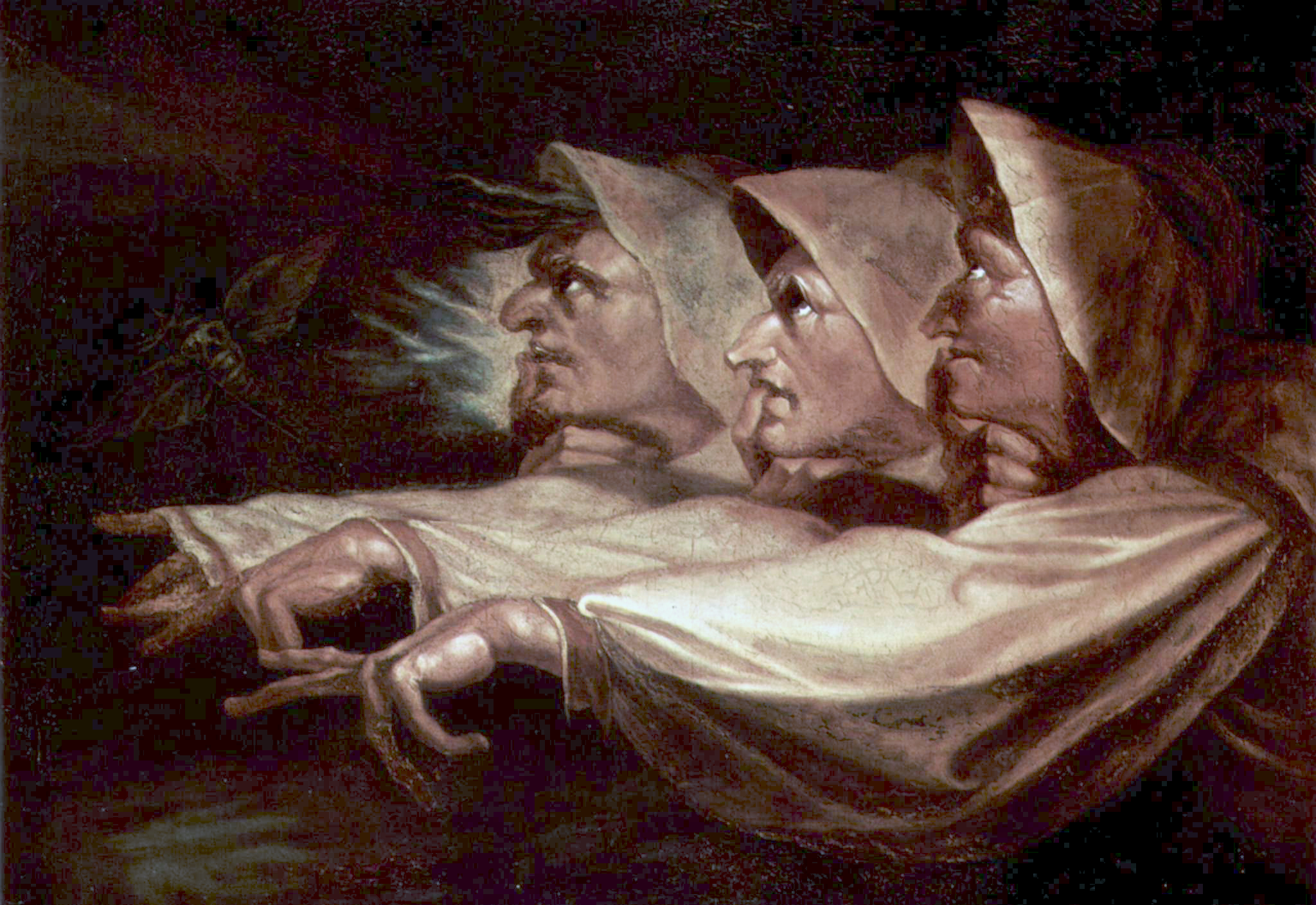
Of all of the Shakespeare plays that I have read, this one probably has the best atmosphere.  King James I was fascinated by the idea of the supernatural and Shakespeare certainly feeds that fascination with this play.  It is full of storms, witches, omens, ghosts, and prophecies.  The image of the three witches casting spells and cooking potions is vivid even on the page.  Over time, this sense of evil foreboding has penetrated even the stage where it is enacted.  Many in the the theatrical world consider the play to be unlucky and refer to it simply as "The Scottish Play" rather than as Macbeth.  As someone who enjoys some darker touches and Gothic stories, I found this atmosphere to be utterly delicious.

The other fascinating aspect of this play are the two lead characters, Macbeth and Lady Macbeth.  While Macbeth has some similarities to Richard III, he lacks the magnetism and pure evilness of that character.  He is a man driven by ambition (as well as insecurity about his own manliness).  He doesn't even think about being king until the idea is suggested to him, but once it is nothing seems more important.  To him, not attaining the crown is worse than murdering his king and guest in cold blood.  As for Lady Macbeth, her very name has become synonymous with the idea of the supreme villainess.  She is also consumed by ambition and suppresses all "feminine" emotions in favor of more brutal, "masculine" ones.  Though it is not seen by the audience,  her smearing of King Duncan's blood on his bodyguards faces is horrifying.  But ambition is never satisfied and as murder after murder is committed, both characters go mad with guilt and are unable to wash the blood from their hands.

Macbeth is perhaps Shakespeare's most unique play.  It's dark atmosphere, ruthless characters, and morality overtones make it stand out.  I really enjoyed it.  And it is also the shortest of the tragedies, so I highly recommend it as a starting point.

The Performance:

Though reading Shakespeare is fun, it is also important to see it performed.  Shakespeare gives few stage directions and this allows each individual give their own interpretation of the characters an their actions.
 
I watched the 1981 performance starring Jeremy Brett and Piper Laurie.  Though it was very much a "stage" setting compared to the other plays I've watched, it was still good.  I love Jeremy Brett's acting and he was wonderful here as well.  Worth a watch, though I really can't wait for the new version with Michael Fassbender to come out!
 
Do you have a favorite performance of this play?  Share it with us in the comments.         

Sunday, August 24, 2014

Henry IV, Part 1

"Two stars keep not their motion in one sphere;"

Written around 1597, Henry IV Part 1 is the second in Shakespeare's four part series dealing with the reigns of the English kings Richard II, Henry IV, and Henry V.  It remains one of Shakespeare's most popular works and includes many memorable characters like Prince Hal, Hotspur, and Sir John Falstaff.  Though it is popular, it's interpretations remain open and continue to evolve with modern readings.

The Plot:

King Henry IV's reign has been anything but quiet.  Not only is his mind disquieted by the murder of his predecessor, Richard II, but rebellion is beginning to arise in the kingdom.  Wales and Scotland are giving trouble on the borders and Henry is increasingly at adds with the powerful Percy family of Northumberland.  Adding to his troubles is the behavior of his eldest son, Hal, the Prince of Wales, who has forsaken the royal court and instead wastes his time in taverns and with low companions like Sir John Falstaff.  King Henry often wishes that Hal were more like Henry Percy (called "Hotspur"), the warrior son of the Duke of Northumberland.

The rebellious groups, including the Percy family, join forces and aim to overthrow the king and divide Britain into thirds. Prince Hal joins his father's army as they march to Shrewsbury where Hotspur's forces, and battle, await them.

My Review (Caution - Spoilers):

This was the second of Shakespeare's "History" plays that I have read.  This was also the one I was most familiar with as it seems to be the most popular of those particular plays.  Though it didn't eclipse Richard III in my opinion, I did enjoy the many different viewpoints it had to offer.

One of my favorite aspects is the idea of the two Henrys, two stars in one sphere.  At first, we share King Henry's view that Hotspur is to be admired above Prince Hal.  Hotspur is a consummate warrior while Hal seems to take pleasure only in drinking and carousing, hardly the desired image of a future king.  But Hal soon tells us that he realizes the degradation the company he keeps brings on him and that he is only biding his time until he can prove that he has the character of a king.  Soon, King Henry learns that the honor and glory found on the battlefield and in the royal court cannot make up for the love a son bears his father.  Though Hal does not seem to be the son his father might have wished, he doesn't hesitate to leave the party life behind in order to defend him and his throne.

Another aspect that must be discussed is the character of Sir John Falstaff.  Perhaps no other comedic Shakespeare character is as well loved or well studied as Falstaff.  On the one hand, he seems to be most of the deadly sins personified.  He is fat, a drunkard, lazy, a thief, boastful, and cowardly.  For many years he is Prince Hal's teacher and leads him in a life of pleasure and debauchery.  But Falstaff has a depth that many characters don't.  His love of Prince Hal is genuine, and he has a quality about him that causes us to feel a bit of sympathy towards him.

This is a solid play and one that many people continue to love.  It has heavy drama with the rebellion scenes balanced with great comedy involving Falstaff's escapades.  I do recommend it as a must read for a general understanding of Shakespeare's works.  Though I wouldn't call it a favorite, it is still one that I'm glad I read.  

The Performance:

Though reading Shakespeare is fun, it is also important to see it performed.  Shakespeare gives few stage directions and this allows each individual give their own interpretation of the characters an their actions.
 
I watched the 2012 production of the play included the BBC's The Hollow Crown.  It stars Tom Hiddleston, Jeremy Irons, Michelle Dockery, and Simon Russell Beale.  It is a fantastic production and a must see.  The acting is spectacular, of course, and the structure of the play is kept mostly intact.  The action scenes are especially well done and it is nice to see it in more of a film setting versus a stage setting.  I highly recommend it.
 
Do you have a favorite performance of this play?  Share it with us in the comments.          

Tuesday, August 5, 2014

Much Ado About Nothing

“When I said I would die a bachelor, I did not think I should live till I were married.”

If you have ever read (or seen) and enjoyed a modern romance story, then you owe a lot to William Shakespeare.  His 1598/1599 comedic play Much Ado About Nothing has set the tone for many of today's most loved romance stories and remains a classic itself.  It is a story that continues to be retold in modern interpretations all over the world and remains a personal favorite of mine.

The Plot:

Leonato, the Governor of Messina, receives word that the Spanish prince Don Pedro is arriving along with his companions after a successful battle.  One of these companions, Count Claudio, instantly falls for Leonato's daughter, Hero.  Meanwhile, Benedick, the other companion, takes his up his war of wit and words with Beatrice, Leonato's niece.  They both profess to hate each other and are constantly throwing verbal punches.  Claudio and Don Pedro come up with a scheme to convince Benedick that Beatrice is in love with him and vice versa, thus causing them to fall in love with each other.  They enlist the help of Hero and meet with immediate success.  Hero also falls for Claudio and the two become engaged.  But Don Perdro's brother, Don Jon, decides to wreck things for the lovers by convincing Claudio that Hero is being unfaithful to him.  Chaos ensues and one wonders if either couple will finally achieve happiness.

My Review (Caution - Spoilers):

This was the first Shakespeare play that I became familiar with and it remains one of my all time favorites.  It is one of those stories that seems to come off of the page with its great characters, witty repartees, and fun plot.

Though Hero and Claudio's story drives much of the action, it is Beatrice and Benedick who are the stars of the show.  I think their story is interesting because you can't tell when they actually begin to fall for each other.  Have they always harbored secret feelings for each other?  Or does percieving weakness in the other (i. e. one being in love with the other) allow them to take down their own defenses and open themselves up to love?  Whatever the cause, their transformation from sarcastic enemies to sarcastic lovers is a fun one to watch.

One of the aspects of this story that I love is the masking of one's identity.  At one point or another, almost every character pretends to be someone they aren't.  Whether it be as a barrier to protect themselves or a way to conceal themselves while creating mischief, each character plays a part that is not really his.  I think this has an interesting correlation with our society today.  We hide behind our avatars and our Twitter handles in order to protect ourselves or to shrug off responsibility for the things we do or say.  Like the characters in the story, we have to open ourselves up to each other in order to experience love and to take responsibility for our actions.

If you are looking for a place to start in Shakespeare, this is a good one.  It is probably one of his most accessible and fun plays.  Probably my favorite comedy so far.

The Performance:

Though reading Shakespeare is fun, it is also important to see it performed.  Shakespeare gives few stage directions and this allows each individual give their own interpretation of the characters an their actions.

I watched Joss Whedon's 2012 film starring Alexis Denisof, Amy Acker, Nathan Fillion, and a host of other people from other Whedon productions.  Though the dialogue is all Shakespeare, the setting is modern.  I truly love this film.  While it is faithful to Shakespeare's lines and plot, its setting allows for a fun and modern interpretation.  All of the actors are outstanding, and Nathan Fillion is especially endearing as the hapless constable, Dogberry.  I also loved how they took the songs in the original play and set them to modern music.  I highly recommend this!

Do you have a favorite performance of this play?  Share with us in the comments!