Showing posts with label Shakespeare. Show all posts

Saturday, September 27, 2014

Antony and Cleopatra

"The breaking of so great a thing should make a greater crack."

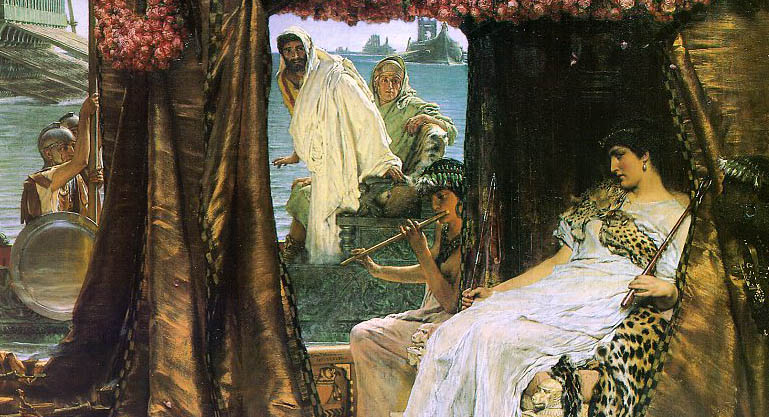
Believed to have been first performed around 1607, this play immortalizes one of history's most famous and captivating love stories...that of Roman general Mark Antony and Cleopatra, Pharaoh of Egypt.  It is a story of passion, betrayal, power, and ambition.  But more than the relationship of two people is at stake as two empires collide and the fate of the world hangs in the balance.

The Plot:

Mark Antony is one of the triumvirs of the Roman Republic, but lately he has been neglecting his duties.  He has fallen in love with Cleopatra and spends his time with her in Egypt.  He ignores Rome's problems, even when his own wife dies after leading a rebellion against Octavius Caesar.  Tensions mount between Antony and Caesar when Antony is called back to Rome to help fight pirates who are terrorizing the Mediterranean.  In an effort to smooth things over and strengthen the bond between the co-rulers, newly widowed Antony marries Caesar's sister, Octavia.

Eventually, Antony is unable to resist returning to Cleopatra.  He abandons his family and has himself and Cleopatra crowned as King and Queen of the eastern third of the Roman Empire.  War is inevitable and both sides prepare for a meeting that will change not only of their own lives, but that of the empire as well.

My Review (Caution - Spoilers):

I wasn't sure what to expect from this particular play, but I ended up enjoying it quite a bit.  It was, in my opinion, the most complex of the Shakespeare plays that I have read.  I enjoyed the Roman setting, and the similarities to the power struggle seen in Macbeth was interesting as well.

The play is structured around the dichotomy of Rome and Egypt.  Rome is portrayed as an almost masculine empire.  It is ruled by men and governed by law and reason.  Honor and strength in battle is considered more important than anything.  Egypt, ruled be a woman, is portrayed as a land of pleasure and sensuality.  Emotion dictates action.  In this world, there is no room for emotion and reason to coexist.  Antony is weak because he allows his desire for Cleopatra to keep him from fulfilling his duties to Rome and to his family.  Though it is line with 17th century thinking, it could certainly rub modern audiances the wrong way.

The role of Cleopatra is considered by many one of Shakespeare's most complex female roles.  At first glance, she seems to embody the manipulative seductress.  She is given to hysterics, uses her changing moods to keep Antony with her, and rules a court given completely to pleasure and sensuality.  And yet, underneath all of that, she is also a skilled ruler.  She shows time and again that she does not use her feminine whiles for selfish pleasure only.  She is Julius Caesar's mistress while he is in power.  She saves her Egyptian fleet at the price of Antony's.  She considers Octavius Caesar's offer of allowing her to keep Egypt in exchange for killing Antony.  And she takes her own life, not in grief for Antony, but rather in fear that she will be taken to Rome as a prize.  It is clear that she is not a character to be put in a box.

This was a nice way to finish my summer reading of Shakespeare.  It is certainly not as cut and dry of a play as it may appear at first glance.  And in many ways, it combines elements of all of the Shakespearean categories...comedy, history, and tragedy.  A good read for anyone who loves Roman history and complicated characters.

The Performance:

Though reading Shakespeare is fun, it is also important to see it performed.  Shakespeare gives few stage directions and this allows each individual give their own interpretation of the characters an their actions.

I watched the 1974 television performance by the Royal Shakespeare Company.  It stars Richard Johnson, Janet Suzman, Corin Redgrave, and Patrick Stewart.  This is the RSC, so naturally it was well acted.  Some of the production values screamed 1970s, but overall it was a good performance.

Do you have a favorite performance of this play?  Share with us in the comments!

Saturday, September 20, 2014

Henry IV, Part 2

Canst thou, O partial sleep, give thy repose
To the wet sea-boy in an hour so rude;
And in the calmest and most stillest night,
With all appliances and means to boot,
Deny it to a king? Then, happy low, lie down!
Uneasy lies the head that wears a crown.

The reign of Henry IV draws to a conclusion in the third of Shakespeare's series of history plays.  Though less known (and less loved) than Part 1, there are moments of mirth and heartbreak  that will remain with the reader (or audiance) forever.

The Plot:

Part 2 picks up right where Part 1 leaves off.  Hotspur is slain, but there are other rebellious parties that must be defeated.  Prince John of Lancaster rides to the north to engage the armies of the Archbishop of York.  Sir John Falstaff makes his way, slowly, behind him gathering men for the royal forces along the way.  Prince Hal seems to slip back into his old habits and company, again grieving his father.  And King Henry IV is weighed down by his crown and feels he is reaching the end of his reign.

My Review (Caution - Spoilers):

As a follow up to Part 1, this particular play seems less dramatic and not as tightly written.  There are no battle scenes, less time is spent amongst the rebels, and Prince Hal and Falstaff only encounter each other twice.  But there were some stand out ideas and scenes that definitely stuck with me.

The first is the decline of King Henry IV.  He is a man who gained his crown through rebellion and has had to fight every moment of his reign to keep it.  His dream of leading a crusade to the Holy Land slowly fades as he realizes that his health and the rebellion in the kingdom will never allow it.  Though he gained what he wanted (the throne of England) he was never able to enjoy it in peace.  His greatest achievement became his greatest curse.  He hopes that Prince Hal will have a more peaceful reign since he will attain the crown legitimately, through inheritance.

The most important part of this play is the transformation of Prince Hal to Henry V.  At the beginning of the play, it seems that he has slipped back into his old habits.  He continues to frequent his old haunts and spend his nights in pleasure.  And yet, it becomes apparent that his perspective is changing.  As his father lies on his deathbed, he considers how much the crown cost the king and what a weight of responsibility it is.  His acceptance of this responsibility and his change in behavior is both wonderful and heartbreaking.  It was good to see him accept the Lord Chief Justice (who had openly scolded his wild behavior) as a mentor.  On the other hand, his dismissal and banishment of his former companions, including Falstaff, comes across as rather harsh.  Though we know that Falstaff is a fool and not someone who should be close to a king, it is obvious that his love for Hal is genuine.  The betrayal he felt must have been devistating.

This is probably the weakest of the Shakespeare plays I have read this summer, yet it is one that should be read along with the other three in the series.  It certainly outlines the burden that comes with power and the strength of character needed to rule wisely.

The Performance:

 Though reading Shakespeare is fun, it is also important to see it performed.  Shakespeare gives few stage directions and this allows each individual give their own interpretation of the characters an their actions.

As with Part I, I watched the 2012 production included in BBC's The Hollow Crown.  It stars Jeremy Irons, Tom Hiddleston, Simon Russell Beale, David Bamber, and Geoffrey Palmer.  It was a wonderful production that beautifully conveyed the heavy emotion of the play.  Definitely worth watching.

Do you have a favorite performance of the this play?  Share with us in the comments!       

Saturday, September 13, 2014

The Tempest

“We are such stuff as dreams are made on, and our little life is rounded with a sleep.” 

Supposedly written in 1610-11, The Tempest is believed by many scholars to be the last play Shakespeare wrote on his own.  Though not very popular with 17th century audiences, it is now considered by many to be one of Shakespeare's greatest works.  In some ways, this particular play is concerned with its own nature, and many early scholars have seen it as Shakepeare's farewell to the theater.  

The Plot:

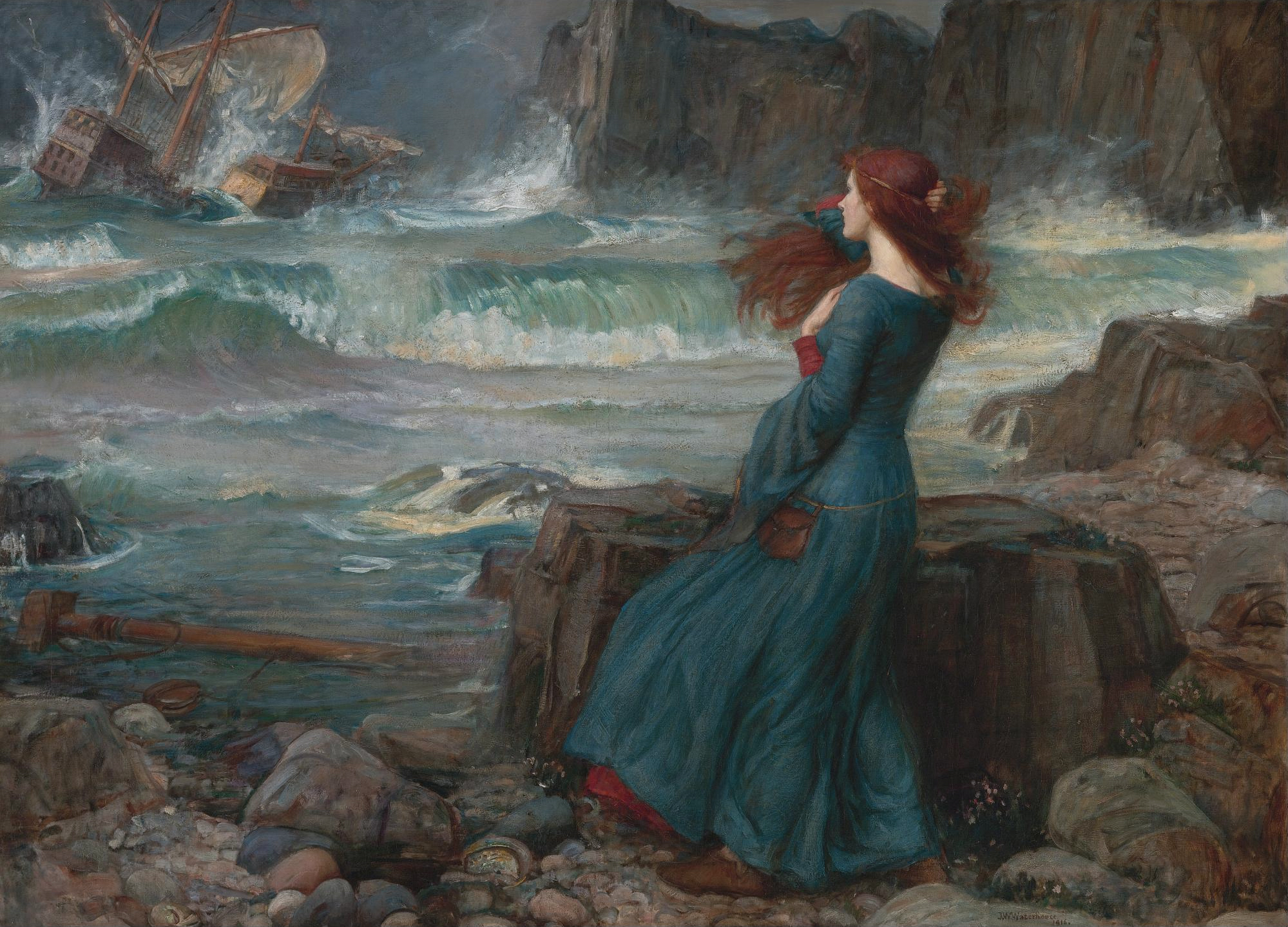
After being usurped by his brother, Prospero, the rightful duke of Milan, and his daughter, Miranda, have lived for 12 years on a deserted island.  Chance brings those who had overthrown him in the vicinity of the island, and Prospero uses his magic arts to cause a storm that washes everyone ashore and scatters them about the island.  This includes his brother, Antonio, Alonso the King of Naples, and the king's son, Ferdinand.  With help of his spirit servant, Ariel, Prospero works to bring all of the company back together and reclaim his rightful place as Duke of Milan.

My Review (Caution - Spoilers):

I was pretty familiar with the plot of this play though I had never actually read it.  It has several different qualities that set it apart from the typical Shakespearean comedy.  I found it to be less laugh out loud, but rather enjoyed the more mystical aspects of it.

As with Macbeth, the atmosphere of The Tempest contributes heavily to the impression it leaves.  While the atmosphere of the former is dark and foreboding, the atmosphere of this play is light and mischievous yet tempered by a solemnity.  The magic of the two plays also contrast well as the spells and dark omens of Macbeth contribute to horror and evil while Prospero's magic is used mainly for good.  I loved the mystical qualities of the play, both playful and solemn.  Ariel, as an immortal spirit, brings fun to the story and his tricks and interactions with the villains of the play are often hilarious.  As a man approaching the end of his life, Prospero is much more straightforward and his often heavy spirit keeps the play from being in the same vein as A Midsummer Night's Dream.  We are much less concerned with characters looking ridiculous than we are in other comedies.

One of the interpretations of the story that I found fascinating was the idea of Shakespeare writing Prospero as himself.  This theory has persisted for many years and is accepted by most critics.  In this theory, the plot is meant to represent the theater and Shakespeare as magician controls the characters and even the very elements.  Yet, like Prospero, Shakespeare is approaching the end of his life and will be letting go of his servants (characters) and his magic arts (writing). "Our revels now are ended.  These our actors, as I foretold you, were all spirits and are melted into air, into thin air..."  This idea of the magician/playwright giving up his magic and retiring from the public eye is both beautiful and sad.  It makes Prospero's final plea to the audience for freedom and release all the more powerful.  "As you from crimes would pardon'd be, let your indulgence set me free."

I think this is the most beautiful of the Shakespeare plays that I have read.  The free use of magic and song, the mischievousness contrasted with villainy, and the reflections of a person at the end of their life all combine to be something rather extraordinary.  Though it may or may not be Shakespeare's final work, it is certainly a fitting send off for history's greatest playwright.  A must read for any Shakespeare lover.

The Performance:

Though reading Shakespeare is fun, it is also important to see it performed.  Shakespeare gives few stage directions and this allows each individual give their own interpretation of the characters an their actions.
 
I watched the 2010 film version starring Helen Mirren, Felicity Jones, Ben Whishaw, and Alan Cumming.  At first I thought that Prospero becoming Prospera would be distracting, but Mirren gave an excellent performance and played the character brilliantly.  All of the acting was wonderful and the CG elements helped keep the "magic" of the play intact.  They also did a great job incorporating the many songs of the play, even turning Prospero's epilogue into the end theme.  Worth a watch in my opinion.
 
Do you have a favorite performance of this play?  Share it with us in the comments.               

Saturday, September 6, 2014

Macbeth

"By the pricking of my thumbs, 
Something wicked this way comes."

More than perhaps any other play, Macbeth signals the change in the English monarchy that occured during Shakespeare's career.  It is believed to have been written after the ascension of King James I to the throne, ending the reign of the House of Tudor and ushering the reign of the Scottish House of Stuart.  It is a story of ambition, witchcraft, superstition, and Scottish history.  Today, it continues to fascinate actors and audiences alike, and carries a stigma with it that haunts the theatrical world.

The Plot:

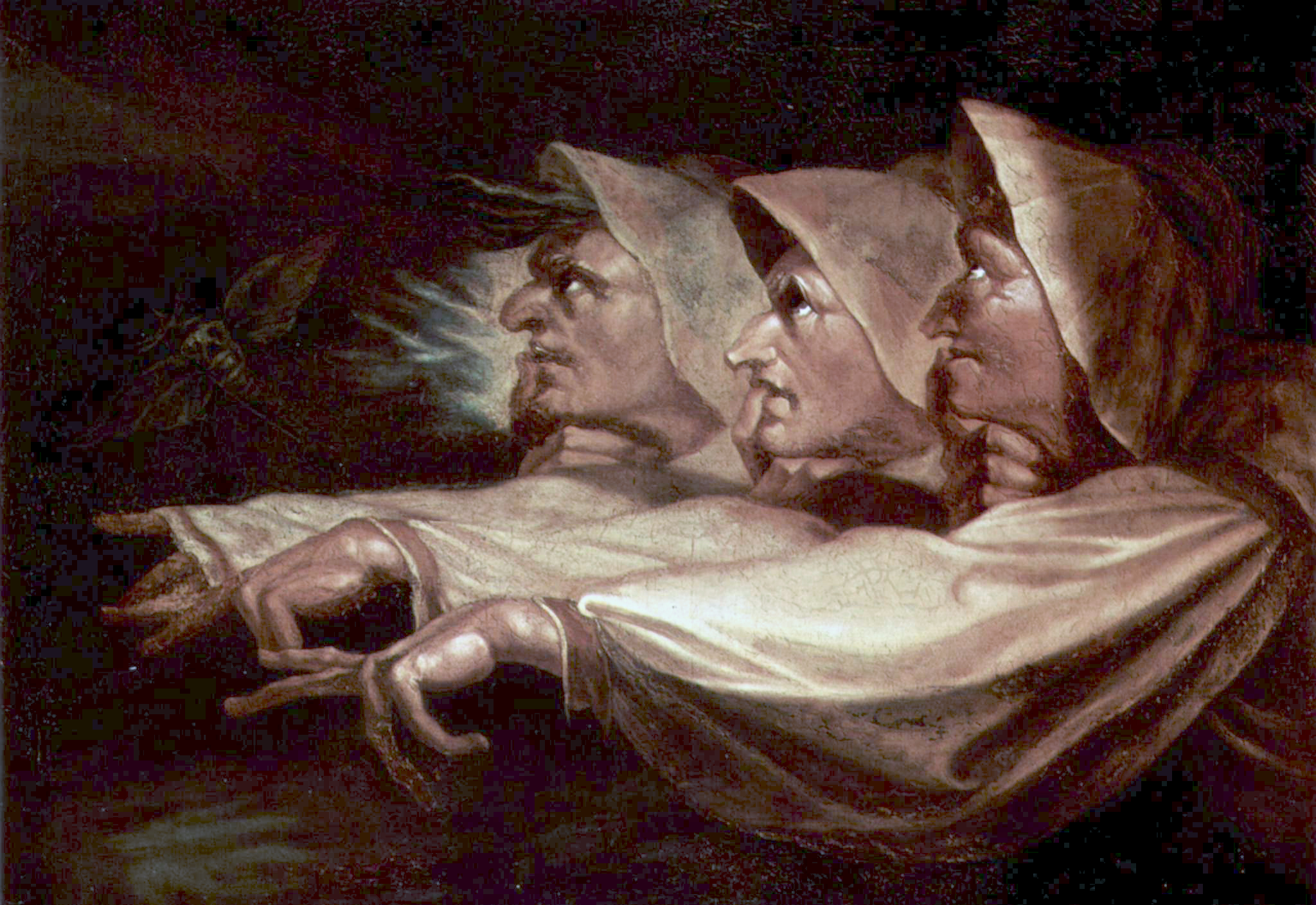
The play opens on three witches, huddling together during a thunderstorm.  The forces of King Duncan of Scotland, led by Macbeth and Banquo, have defeated the armies of the kings of Norway and Ireland.  As Macbeth and Banquo return home, they encounter the witches who prophesy that Macbeth is now Thane of Cawdor and will one day be King of Scotland.  Macbeth scoffs at this idea until a messenger arrives announcing that King Duncan has made Macbeth Thane of Cawdor as a reward for his victory.

Macbeth bears the news to his wife who latches onto the idea of her husband becoming king.  She persuades him to murder Duncan while he stays at their home, questioning his manhood when he initially refuses.  The deed is done and Macbeth is pronounced king.  But his guilt and paranoia plague him and he is forced to commit more murders in order to keep his throne secure.  

My Review (Caution - Spoilers):

I had only a vague idea of Macbeth's plot and was unsure of how it would appeal to me.  I actually enjoyed it quite a bit and think it might just be my favorite of the Shakespeare's tragedies that I have read.

Of all of the Shakespeare plays that I have read, this one probably has the best atmosphere.  King James I was fascinated by the idea of the supernatural and Shakespeare certainly feeds that fascination with this play.  It is full of storms, witches, omens, ghosts, and prophecies.  The image of the three witches casting spells and cooking potions is vivid even on the page.  Over time, this sense of evil foreboding has penetrated even the stage where it is enacted.  Many in the the theatrical world consider the play to be unlucky and refer to it simply as "The Scottish Play" rather than as Macbeth.  As someone who enjoys some darker touches and Gothic stories, I found this atmosphere to be utterly delicious.

The other fascinating aspect of this play are the two lead characters, Macbeth and Lady Macbeth.  While Macbeth has some similarities to Richard III, he lacks the magnetism and pure evilness of that character.  He is a man driven by ambition (as well as insecurity about his own manliness).  He doesn't even think about being king until the idea is suggested to him, but once it is nothing seems more important.  To him, not attaining the crown is worse than murdering his king and guest in cold blood.  As for Lady Macbeth, her very name has become synonymous with the idea of the supreme villainess.  She is also consumed by ambition and suppresses all "feminine" emotions in favor of more brutal, "masculine" ones.  Though it is not seen by the audience,  her smearing of King Duncan's blood on his bodyguards faces is horrifying.  But ambition is never satisfied and as murder after murder is committed, both characters go mad with guilt and are unable to wash the blood from their hands.

Macbeth is perhaps Shakespeare's most unique play.  It's dark atmosphere, ruthless characters, and morality overtones make it stand out.  I really enjoyed it.  And it is also the shortest of the tragedies, so I highly recommend it as a starting point.

The Performance:

Though reading Shakespeare is fun, it is also important to see it performed.  Shakespeare gives few stage directions and this allows each individual give their own interpretation of the characters an their actions.
 
I watched the 1981 performance starring Jeremy Brett and Piper Laurie.  Though it was very much a "stage" setting compared to the other plays I've watched, it was still good.  I love Jeremy Brett's acting and he was wonderful here as well.  Worth a watch, though I really can't wait for the new version with Michael Fassbender to come out!
 
Do you have a favorite performance of this play?  Share it with us in the comments.         

Sunday, August 24, 2014

Henry IV, Part 1

"Two stars keep not their motion in one sphere;"

Written around 1597, Henry IV Part 1 is the second in Shakespeare's four part series dealing with the reigns of the English kings Richard II, Henry IV, and Henry V.  It remains one of Shakespeare's most popular works and includes many memorable characters like Prince Hal, Hotspur, and Sir John Falstaff.  Though it is popular, it's interpretations remain open and continue to evolve with modern readings.

The Plot:

King Henry IV's reign has been anything but quiet.  Not only is his mind disquieted by the murder of his predecessor, Richard II, but rebellion is beginning to arise in the kingdom.  Wales and Scotland are giving trouble on the borders and Henry is increasingly at adds with the powerful Percy family of Northumberland.  Adding to his troubles is the behavior of his eldest son, Hal, the Prince of Wales, who has forsaken the royal court and instead wastes his time in taverns and with low companions like Sir John Falstaff.  King Henry often wishes that Hal were more like Henry Percy (called "Hotspur"), the warrior son of the Duke of Northumberland.

The rebellious groups, including the Percy family, join forces and aim to overthrow the king and divide Britain into thirds. Prince Hal joins his father's army as they march to Shrewsbury where Hotspur's forces, and battle, await them.

My Review (Caution - Spoilers):

This was the second of Shakespeare's "History" plays that I have read.  This was also the one I was most familiar with as it seems to be the most popular of those particular plays.  Though it didn't eclipse Richard III in my opinion, I did enjoy the many different viewpoints it had to offer.

One of my favorite aspects is the idea of the two Henrys, two stars in one sphere.  At first, we share King Henry's view that Hotspur is to be admired above Prince Hal.  Hotspur is a consummate warrior while Hal seems to take pleasure only in drinking and carousing, hardly the desired image of a future king.  But Hal soon tells us that he realizes the degradation the company he keeps brings on him and that he is only biding his time until he can prove that he has the character of a king.  Soon, King Henry learns that the honor and glory found on the battlefield and in the royal court cannot make up for the love a son bears his father.  Though Hal does not seem to be the son his father might have wished, he doesn't hesitate to leave the party life behind in order to defend him and his throne.

Another aspect that must be discussed is the character of Sir John Falstaff.  Perhaps no other comedic Shakespeare character is as well loved or well studied as Falstaff.  On the one hand, he seems to be most of the deadly sins personified.  He is fat, a drunkard, lazy, a thief, boastful, and cowardly.  For many years he is Prince Hal's teacher and leads him in a life of pleasure and debauchery.  But Falstaff has a depth that many characters don't.  His love of Prince Hal is genuine, and he has a quality about him that causes us to feel a bit of sympathy towards him.

This is a solid play and one that many people continue to love.  It has heavy drama with the rebellion scenes balanced with great comedy involving Falstaff's escapades.  I do recommend it as a must read for a general understanding of Shakespeare's works.  Though I wouldn't call it a favorite, it is still one that I'm glad I read.  

The Performance:

Though reading Shakespeare is fun, it is also important to see it performed.  Shakespeare gives few stage directions and this allows each individual give their own interpretation of the characters an their actions.
 
I watched the 2012 production of the play included the BBC's The Hollow Crown.  It stars Tom Hiddleston, Jeremy Irons, Michelle Dockery, and Simon Russell Beale.  It is a fantastic production and a must see.  The acting is spectacular, of course, and the structure of the play is kept mostly intact.  The action scenes are especially well done and it is nice to see it in more of a film setting versus a stage setting.  I highly recommend it.
 
Do you have a favorite performance of this play?  Share it with us in the comments.          

Tuesday, August 5, 2014

Much Ado About Nothing

“When I said I would die a bachelor, I did not think I should live till I were married.”

If you have ever read (or seen) and enjoyed a modern romance story, then you owe a lot to William Shakespeare.  His 1598/1599 comedic play Much Ado About Nothing has set the tone for many of today's most loved romance stories and remains a classic itself.  It is a story that continues to be retold in modern interpretations all over the world and remains a personal favorite of mine.

The Plot:

Leonato, the Governor of Messina, receives word that the Spanish prince Don Pedro is arriving along with his companions after a successful battle.  One of these companions, Count Claudio, instantly falls for Leonato's daughter, Hero.  Meanwhile, Benedick, the other companion, takes his up his war of wit and words with Beatrice, Leonato's niece.  They both profess to hate each other and are constantly throwing verbal punches.  Claudio and Don Pedro come up with a scheme to convince Benedick that Beatrice is in love with him and vice versa, thus causing them to fall in love with each other.  They enlist the help of Hero and meet with immediate success.  Hero also falls for Claudio and the two become engaged.  But Don Perdro's brother, Don Jon, decides to wreck things for the lovers by convincing Claudio that Hero is being unfaithful to him.  Chaos ensues and one wonders if either couple will finally achieve happiness.

My Review (Caution - Spoilers):

This was the first Shakespeare play that I became familiar with and it remains one of my all time favorites.  It is one of those stories that seems to come off of the page with its great characters, witty repartees, and fun plot.

Though Hero and Claudio's story drives much of the action, it is Beatrice and Benedick who are the stars of the show.  I think their story is interesting because you can't tell when they actually begin to fall for each other.  Have they always harbored secret feelings for each other?  Or does percieving weakness in the other (i. e. one being in love with the other) allow them to take down their own defenses and open themselves up to love?  Whatever the cause, their transformation from sarcastic enemies to sarcastic lovers is a fun one to watch.

One of the aspects of this story that I love is the masking of one's identity.  At one point or another, almost every character pretends to be someone they aren't.  Whether it be as a barrier to protect themselves or a way to conceal themselves while creating mischief, each character plays a part that is not really his.  I think this has an interesting correlation with our society today.  We hide behind our avatars and our Twitter handles in order to protect ourselves or to shrug off responsibility for the things we do or say.  Like the characters in the story, we have to open ourselves up to each other in order to experience love and to take responsibility for our actions.

If you are looking for a place to start in Shakespeare, this is a good one.  It is probably one of his most accessible and fun plays.  Probably my favorite comedy so far.

The Performance:

Though reading Shakespeare is fun, it is also important to see it performed.  Shakespeare gives few stage directions and this allows each individual give their own interpretation of the characters an their actions.

I watched Joss Whedon's 2012 film starring Alexis Denisof, Amy Acker, Nathan Fillion, and a host of other people from other Whedon productions.  Though the dialogue is all Shakespeare, the setting is modern.  I truly love this film.  While it is faithful to Shakespeare's lines and plot, its setting allows for a fun and modern interpretation.  All of the actors are outstanding, and Nathan Fillion is especially endearing as the hapless constable, Dogberry.  I also loved how they took the songs in the original play and set them to modern music.  I highly recommend this!

Do you have a favorite performance of this play?  Share with us in the comments!    
Saturday, July 26, 2014

Just for Fun


Thought this would be fun to post since I am almost two thirds of the way through my summer reading of Shakespeare.  From the 1953 version of Cole Porter's Kiss Me Kate, here is "Brush Up Your Shakespeare".

Saturday, July 12, 2014

Hamlet

“There are more things in Heaven and Earth, Horatio, than are dreamt of in your philosophy.”

Of all the plays and poems written by William Shakespeare, there is perhaps none as iconic as Hamlet.  It is required reading for many students around the world and its lines and images are often what we envision when we think of Shakespeare.  It seems to have been his most popular play in his lifetime, and the role of the Danish prince remains a right of passage for today's Shakespearean actors. 

The Plot:

Prince Hamlet is mourning the recent passing of his father, the King of Denmark.  His uncle Claudius has assumed the throne and hastily married Hamlet's mother, Queen Gertrude.  Hamlet is told of the mysterious sightings of a ghost resembling his dead father who is haunting the castle.  He goes to investigate and discovers that it is indeed the ghost of the old king.  The king tells Hamlet that he was was cruelly murdered by Claudius who coveted both his crown and his queen, and he charges Hamlet to exact revenge by killing Claudius.

Hamlet is uncertain of whether he can trust the ghost.  He begins to act as if he has lost his wits and Claudius and Gertrude struggle to understand what may have caused it.  There is talk that he may be crazy due to love for Ophelia whose father, the Chief Counselor, has opposed the match.  Events soon convince Hamlet that the ghost's story is true and he seeks to enact his revenge, even as Claudius tries to secretly have Hamlet killed.

My Review (Caution - Spoilers):

Like most people, I was pretty familiar with the plot of Hamlet, though I had never actually read it.  It is Shakespeare's longest play and at times it can certainly feel like it.  The action alternates between slow and quick which at times can give it an uneven feeling.  But this is a classic for a reason and you can certainly see the influence it has had on our modern stories.

There is a lot going on this play that really highlights the upheaval of Shakespeare's time.  In many ways, the play has both a "modern" and a "medieval" feel.  The setting has a medieval feel with the ghost of a warrior king, revenge, and discussions of purgatory and "Christian burial".  But other parts, especially Hamlet himself, have a much more Renaissance flavor with lots of philosophizing, skepticism of the supernatural, and madness.  That is probably part of the reason the play remains popular today, because there are elements that we recognize as belonging to our times and not just the distant past.

This is one of the most quoted works in English literature and I was constantly discovering phrases that I did not realize came from this play.  Phrases like "To thine own self be true", "method in the madness", "Brevity is the soul of wit", "Sweets to the sweet", and "The lady doth protest too much".  Again, because it is such a huge part of our culture, everything about this play felt familiar.  That is great in some ways, but it also kept me from completely loving the play as there didn't seem to be anything "new" for me to discover.

I think this is a play that everyone should read simply to understand the cultural implications of the work.  It is certainly one of English literature's most important works, and Shakespeare's as well.  A good play, I just don't see it being one of my all time favorites.

The Performance:

 Though reading Shakespeare is fun, it is also important to see it performed.  Shakespeare gives few stage directions and this allows each individual give their own interpretation of the characters an their actions.

I watched the 2009 PBS Great Performances version starring David Tennant as Hamlet.  It has a modern spin that is nice without being distracting.  The performances were also great with Tennant pulling off a Hamlet that could easily flip between sober and reflective to crazy and unpredictable.  Patrick Stewart was also wonderful as Claudius/Ghost, but who would expect anything less.  There are some scenes that are cut (Fortinbras does not come in at the end of the play), but overall it is a wonderful adaptation of the play.

Do you have a favorite performance of this play?  Share it below!               

Tuesday, July 1, 2014

Shakespeare in OP

Hannah at Miss Daydreamer's Place posted this video on her blog and I thought it was very timely considering that I am reading Shakespeare for the summer.  Worth a watch if you love Shakespeare or the history of language!


Monday, June 23, 2014

Richard III

"Now is the winter of our discontent made glorious summer by this sun of York;"

Written in approximately 1592, Shakespeare's play based on the life of England's King Richard III is one of power, fate, murder, sorrow, and liberation.  Following both Richards bloody, almost secretive rise to power and his short reign, the play defines him and determines how people will think of him for centuries to come.

The Plot:

The wars between the House of Lancaster and the House of York have seemingly come to and end with the defeat of Henry VI.  Richard, Duke of Gloucester, a younger brother of the new king, laments his physical condition as a deformed hunchback.  He proclaims himself a villain to the audience and seeks to gain the crown for himself.  Though the nobles of the kingdom are warned of Richard's intentions by the former queen, Margaret, Richard is able to charm them all into believing he has only the best intentions.

One by one, he is able to remove those who stand between him and the throne.  Too late do those around him realize that he will stop at nothing to seize it.  But even once the crown is his, he is not safe as a new threat in the shape of Henry Tudor emerges from France.  Deserted by those around him, Richard seeks to retain the throne he gained by the blood of others.

My Review (Caution - Spoilers):

I've read a number of Shakespeare plays, but this is without a doubt my favorite so far.  I thoroughly enjoyed every second of it from the classic struggle for power to the immortal lines from Shakespeare's pen.  This is certainly one I see myself indulging in over and over again.

I think the most striking thing about this play is the character of Richard himself.  From the very first soliloquy, he admits to the audience that he is a villain who will stop at nothing to steal the throne for himself.  And yet at the same time we feel ourselves drawn to him.  Perhaps it is his deformities which he blames for his lot in life.  Perhaps it is his witty charm and magnetism.  Perhaps it is because he speaks to us directly.  For whatever reason we cannot simply loathe him and our feelings become very complicated.  I think it is very telling that some editions refer to this play as the "Tragedy of Richard III" rather than the "History of Richard III".  You can certainly see how this character has affected our modern portrayals of villains in stories (I'm thinking especially of Loki in Thor and The Avengers). 

Of course, this magentism is really only a factor in the first half of the play.  As time goes on, Richard speaks less and less directly with the audience.  We begin to view him only through his actions and their affect on others which are not good.  Slowly he is becoming the pure villain he always claimed to be, desperately struggling to retain the throne he stole.  It is also clear by the end that Henry Tudor is our new hero.  We see him riding in to free England from Richard's tyranny and bring peace to the land by marrying a daughter of the House of York.  In one of the best scenes in the play, the ghosts of those whom Richard has murdered simultaneously curse him and bless Henry Tudor.  The transformation of Richard to evil personified and the House of Tudor to England's saving grace is complete.

I honestly can't recommend this play highly enough.  If you love English history, political intrigue, and complicated anti-heros, then this is for you.  A must read for anyone who is trying out Shakespeare!

The Performance:

 Though reading Shakespeare is fun, it is also important to see it performed.  Shakespeare gives few stage directions and this allows each individual give their own interpretation of the characters an their actions.

I watched the 1955 film version starring Sir Laurence Olivier.  Though there are some scenes/characters that are cut, it is still considered by many to be the definitive version.  Olivier, of course, delivers Shakespeare's lines with ease and his portrayal of the deformed king is now what most people think of when they hear the play's title.  A great version of an amazing play.

Do you have a favorite performance of this play?  Share it below!     

Sunday, June 15, 2014

Twelfth Night

“If music be the food of love, play on.” 

Along with other classics like As You Like It and A Midsummer Night's Dream, Twelfth Night is considered by many to be one of Shakespeare's best comedies.  It is a story of the pain of love, mistaken identities, and the pitfalls of ambition.  Over 400 years after its creation, this play still continues to enchant audiences the world over and forms the basis of or own modern storytelling.

The Plot:

During a storm off the coast of the Kingdom of Illyria, the ship carrying Viola and her twin brother, Sebastian, sinks.  After washing ashore and assuming her brother has drowned, Viola decides to disguise herself as a man, calling herself Cesario.  She enters the services of Orsino, a nobleman who is in love with a noblewoman named Olivia.  Olivia has rejected Orsino's proposal, but he decides to send Cesario (Viola) to woo her on his behalf.  Though she herself has fallen in love with Orsino, Viola obeys him and sets out (as Cesario) to secure Olivia's love for her master.  Olivia continues to spurn Orsino's advances, but she is intrigued by his messenger and is soon falling for the young "man".  As if things weren't complicated enough, Sebastian also survived and has arrived Illyria.  His uncanny resemblance to Viola causes even more confusion.  How will these tangled relationships work themselves out?

My Review (Caution - Spoilers):

In Shakespeare's time and before, Twelfth Night (Jan. 6) was a day where everything was topsy turvy.  Servants dressed up as their masters, men as women, and vice versa.  It was day of revelry,
 hiding one's true identity, and licensed disorder.  We see this played out in the plot.  The general order of things is turned completely upside down.  Gender roles are switched around and general merriment is participated in by all.  Malvolio, Olivia's chief servant, is an embittered man who puts a damper on all of the revelry and in turn is made the cause of even more of it.  

I think what is most striking about Shakespeare's comedies is how much they continue to influence our entertainment today.  There isn't a romantic comedy out there that doesn't in some way draw from Shakespeare's legacy.  This one has many of the familiar tropes.  Mistaken identities, gender disguises, forged letters, love triangles...all of these are now familiar to our modern audiences.  Though they can seem rather cliche now, Shakespeare's wonderful use of language and immortal characters help keep things fresh.  I especially enjoyed the witty Fool Feste and the witless fool Sir Andrew Aguecheek.

This was a fun read, though familiar in many ways.  The plot is solid (for what it is), the language witty, and the characters unforgettable.  In short, it is everything that we have come to expect and enjoy in a Shakespeare comedy.

The Performace:

Though reading Shakespeare is fun, it is also important to see it performed.  Shakespeare gives few stage directions and this allows each individual give their own interpretation of the characters an their actions.

I watched the 1988 TV version of Kenneth Branagh's original stage direction.  It starred Frances Barber, Christopher Ravenscroft, and Richard Briers.  The setting was changed to a Victorian-like time period which allowed for some interesting scene interpretations.  It was solidly acted and a treat to watch.  

Do you have a favorite performance of this play?  Share it below!        

Saturday, May 3, 2014

Literary Moments in Scotland

I'm recently back home after a two week adventure in Scotland.  My grandfather and I had an amazing time traveling all over the country from Edinburgh and Inverness to the Isle of Skye and Oban.  Though the trip mainly revolved around history, whisky, and jaw-dropping scenery we still had a few literary related moments on the trip.  Here is a glimpse at some of them:

Deacon Brodie's Tavern, Edinburgh

Located on the Royal Mile between Edinburgh Castle and Holyrood Palace, this tavern is named for William Brodie, a cabinet maker in Edinburgh in the 18th century.  By day, he was a respected and prominent citizen.  By night, he was a thief, gambler, and womanizer.  This double existence was the inspiration for Robert Louis Stevenson's classic story The Strange Case of Dr. Jekyll and Mr. Hyde.

"Tam O'Shanter" Chair at Holyrood Palace, Edinburgh

Visiting Holyrood Palace was special enough for this history buff.  I literally had to take a moment to collect myself after climbing the stairs from Darnley's chamber to Mary's and standing in the room where Rizzio was murdered.  There is also a nice piece of literary history in the palace.  Created in 1822, this chair was built from part of the collapsed roof of the Kirk of Alloway, the hometown of Robert Burns.  The back has an inset of brass panels with his classic poem "Tam O'Shanter" inscribed on them.
 
The Scott Monument, Edinburgh

Personally, I think it looks more like a shrine to a pagan god rather than a memorial to a Scottish writer.  Located in Edinburgh's New Town, this monument honors Scotland's most famous author and the man who perhaps has done more for Scotland's image than any other.  From Ivanhoe to the Waverly novels, Sir Walter Scott's body of work remains a must-read even to this day.
 
St. Oran's Cemetery, Isle of Iona

Believed to be the burial place of many kings including Scottish, Norwegian, and Irish.  And who can blame them as the beautiful and peaceful setting makes for a lovely final resting place.  It is also believed to be the burial place of that Scottish king made so famous by Shakespeare...Macbeth.
 
It was nice to have a moment revolving around Scotland's most important authors.  If you have been to Scotland, please feel free to share your favorite literary moments with us.  Below are some of my other favorite moments from the trip.

Standing atop Hadrian's Wall

Learning the fine points of whisky making in Oldmeldrum
 
Finding an ancient stone circle hidden in a stand of trees near Banchory

Paying respect to the dead at Culloden

Monster hunting on Loch Ness

Out of this world scenery on the Isle of Skye

Finding peace on the sacred Isle of Iona


Friday, January 10, 2014

2014 Shakespeare Reading Challenge

This year marks the 450th birthday of William Shakespeare.  To celebrate, I had already planned on reading his plays as my summer challenge, and the 2014 Shakespeare Reading Challenge hosted by Caffinatedlife.net fit in perfectly with my plans.  I'm going for the "Frequent Theater-Goer" level by reading 9 plays over the summer.  Here are the ones I have chosen:

Comedies
  • Much Ado About Nothing
  • The Tempest
  • Twelfth Night

Histories
  • Henry IV, Part 1
  • Henry IV, Part 2
  • Richard III

Tragedies
  • Hamlet
  • Macbeth
  • Anthony & Cleopatra

Looking forward into delving into the works of the Bard!  You can join this challenge at anytime during 2014.  If you are signed up for any other challenges, share with us below! 

Saturday, October 29, 2011

Fakespeare?

If you've been on the internet at all lately, you have probably heard the buzz that is going on about the new Shakespeare movie. No, this is not a new adaption of one of his plays; and no, this movie isn't a straight up biopic of Shakespeare's life. It is a film that centers around the idea that Shakespeare never wrote any of the great plays that history has credited to him.

This is not a new idea, by any means. Scholars have been debating his authorship of what is arguably the single most important body of work in the English language. Any number of other Elizabethans have been suggested like Sir Francis Bacon, Christopher Marlowe, William Stanley Earl of Derby, and (as in Anonymous) Edward de Vere Earl of Oxford. But though this idea has been bounced around for centuries, today's audience seems to be taking particular offense to it. In Warwickshire, England (Shakespeare's home turf), they have been temporarily covering Shakespeare's name on area signs to protest the film. Dr. Paul Edmondson of the Shakespeare Birthplace Trust said "This film flies in the face of a mass of historical fact, but there is a risk that people who have never questioned the authorship of Shakespeare's works could be hoodwinked."

Ron Rosenbaum over at Slate.com wrote an article describing the top 10 things he hated about the film. "The conspiracy theorists who waste time trying to browbeat the credulous into thinking that the works of William Shakespeare were actually ghostwritten by Someone Else (in "Anonymous", it’s the Earl of Oxford) can’t stop. They have invested too much of their lives in the chuckleheaded fantasy to give it up now, despite how ridiculous the film reveals it to be." The actors in the film insist that there should not be this sense of ownership over Shakespeare, but rather an appreciation for the works themselves, regardless of the author was.

So what is my take on all of this? I haven't seen the film (and it's not exactly at the top of my list), but I do have a few thoughts on the subject. First off, if you really think that the average Joe is going to start questioning Shakespeare's authorship based on a movie, you're crazy. The average Joe couldn't care less if these plays and poems were written by Shakespeare, the Earl of Oxford, or Dr. Seuss. And as with most conspiracy theories, this one will be accepted by some and ignored by the rest. Secondly, you have to remember this is Hollywood, and historical (or literary) fact is not their number one (two, three, four, etc.) priority. I used to spend a lot of time nitpicking films and getting mad if they didn't hold true to the original, but I've slowly been giving that up and simply taking film for what it is...entertainment. Finally, the actors in this film are right in a way. Ultimately, it doesn't matter who the author of these works was. The important thing is that they were written, and continue to enthrall, surprise, and teach us centuries later. Beowulf is no less important for our not knowing who the author was, and the same can hold true for Hamlet, The Tempest, and Richard III.

What do you think? Are people right to be upset? Is Shakespeare's authorship something that must be protected? Or is this all much ado about nothing?

Saturday, April 23, 2011

Happy Birthday To:

Today is the day the world remembers one who is considered by most to be the greatest writer in the English language...William Shakespeare. Born in 1564, Shakespeare would rise from obscurity to cement himself in literary history, and write many works that remain very popular today. I am a big Shakespeare fan myself, and while I adore his plays, his sonnets have a particular place in my heart. Below are some of my favorites. Let's celebrate the Bard today!


Sonnet 116 as seen in Sense and Sensibility


Sonnet 129 performed by Matthew MacFadyen in Essential Poems


Sonnet 18 read by David Tennant (Dr. Who)


Sonnet 130 read by Alan Rickman (Harry Potter)

Monday, June 16, 2008

All the World's A Stage...

Last Friday evening, I had the opportunity to see a local production of Shakespeare's classic play The Taming of the Shrew. It was wonderful to be able to relax in the newly renovated amphitheatre, with a cool breeze blowing over the lake carrying the scent of wine, cheese and bug spray. This is the third year that I and some of my family have attended these annual productions, and all of them have been really enjoyable. Even my dad, whose idea of great entertainment consists mainly of watching The Three Stooges, has enjoyed them (though he would never openly admit it). Though reading Shakespeare's works is all well and good, nothing can compare with seeing it performed. His vivid characters and witty dialogues come alive and help you to see why his works have been so popular for centuries. If you have never seen a Shakespeare played performed, I would greatly encourage you to do so. Many states and cities have annual Shakespeare festivals and productions. If you have seen productions of Shakespeare's works, which ones were your favorites (mine was Loves Labours Lost)? Which ones would you like to see but haven't? Have you ever been disappointed in a Shakespeare play? Sound off on the Bard of Avon!